
Most companies start entity management in a spreadsheet, and for a while, it works. One entity, one tab, one person keeping it updated. The trouble starts quietly — a second entity, then a third, then a colleague opens last quarter’s version by mistake and updates the wrong one. Nobody decided to make entity management risky. It just grew past what a spreadsheet was ever built to handle.
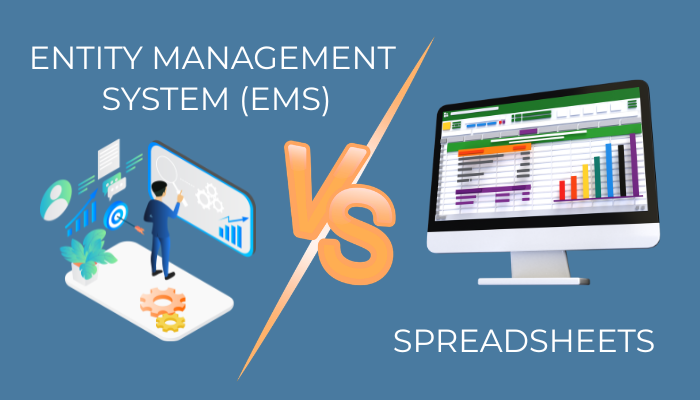
Here’s where spreadsheets actually break down, and what changes when a dedicated entity management system replaces them.
Where Spreadsheets Break Down
Version control. Once more than one person touches the file, “which version is current” becomes a real question — and the wrong answer usually surfaces during an audit or a deal, not before.
No compliance calendar. A spreadsheet can list a filing deadline, but it can’t alert anyone before that deadline arrives. Someone has to remember to check it, for every entity, on every jurisdiction’s own calendar.
No document layer. Certificates of incorporation, board resolutions, and registered-agent letters end up scattered across email and shared drives, disconnected from the entity record that references them.
No audit trail. When a director’s name or an ownership percentage changes, a spreadsheet just overwrites the old value. There’s no record of who changed what, or when.
Doesn’t scale with structure. A single tab can show one entity’s details. It can’t easily show how ten entities relate to each other — parent, subsidiary, ownership percentage — without a lot of manual diagramming that goes stale the moment something changes.
The Tipping Point: When Spreadsheets Stop Being Enough
There’s no fixed entity count where this happens, but a few signals are consistent across companies that make the switch: more than one person needs to update entity data; more than two or three entities exist across different jurisdictions; a fundraise, audit, or acquisition requires producing accurate entity records on short notice; or a filing has already been missed because no one owned tracking it. Any one of these is a reasonable trigger on its own — together, they usually mean the spreadsheet has already become the risk it was supposed to prevent.
What Actually Changes With an Entity Management System
One current record, not several file versions. Everyone who needs entity data looks at the same live system instead of whoever has the newest export.
Deadlines that surface themselves. A real compliance calendar tracks each entity’s actual filing and renewal requirements by jurisdiction and sends alerts ahead of the deadline, instead of relying on someone remembering to check.
Documents attached to the record they belong to. Certificates, resolutions, and filings live with the entity they describe, searchable rather than buried in email.
A visible structure. Ownership and reporting lines across entities are viewable at a glance, and stay accurate as the structure changes — rather than a diagram that was correct as of the last time someone updated it.
How Corpiya Supports the Move Off Spreadsheets
Corpiya Tech (Entity Management System)
Migration support is part of onboarding: Corpiya maps your existing spreadsheet data to structured entity records, loads supporting documents into a searchable library, and sets up compliance alerts for the deadlines you were tracking by hand. See the Entity Management System.Corpiya Business Services (Execution)
Once a filing is flagged, it can be routed directly to Corpiya’s in-country teams for annual compliance and corporate secretarial work, rather than sitting as an unassigned task.Corpiya Counsel (Legal Services)
Governance and contract support for the layer above day-to-day entity tracking — see Corporate Governance & Compliance services.
Conclusion: The Spreadsheet Was Never the Plan
No one sets out to run entity management on spreadsheets forever — it’s just where every company starts, and where too many stay well past the point it’s safe. The cost of switching to a dedicated system is a known, one-time migration. The cost of not switching is a missed filing, a version conflict during a deal, or an audit that takes weeks longer than it should — and that cost tends to show up at the worst possible time.
See how Corpiya’s Entity Management System replaces spreadsheet tracking:
https://corpiya.com/tech/ems/
Or contact us directly:
contact@corpiya.com
Disclaimer: This article is provided for general informational purposes only and does not constitute legal advice. Sebastien Gaddini is licensed to practice law in New York; this piece addresses business-operations topics in a non-legal, informational capacity and should not be relied upon as legal counsel. For advice specific to your situation, consult a qualified attorney licensed in the relevant jurisdiction.

Put These Insights Into Action
Talk to our team about how this applies to your operations — wherever your business takes you, Corpiya is ready to support your next move.
Get In Touch
Related Insights
-
Entity Management System vs. Spreadsheets: Why Companies Make the Switch
Spreadsheets work fine for one or two entities. Past that, they quietly become the biggest risk in your compliance process.…
-

How to Outsource International Back-Office Operations Without Losing Control
Companies that expand into new markets usually replicate their domestic back office locally, country by country — hiring a separate…
-

How Long Does Company Formation Take in Latin America? A Market-by-Market Timeline
Company formation timelines vary widely across Mexico, Brazil, Colombia, Chile, Peru, Ecuador, and Argentina — and the step that actually…