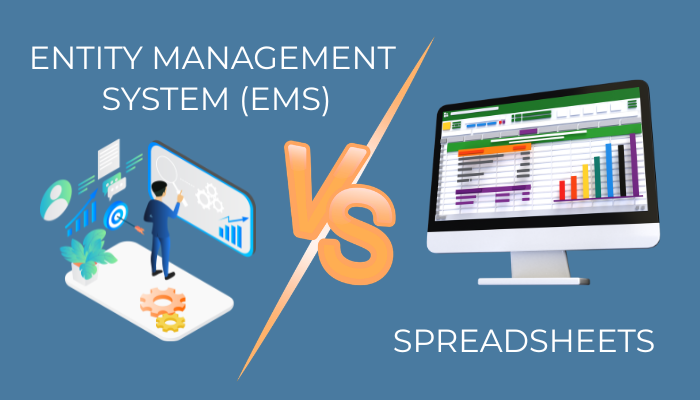
Most companies start entity management in a spreadsheet, and for a while, it works. One entity, one tab, one person keeping it updated. The trouble starts quietly — a second entity, then a third, then a colleague opens last quarter’s version by mistake and updates the wrong one. Nobody decided to make entity management risky. It just grew past what a spreadsheet was ever built to handle.

Here’s where spreadsheets actually break down, and what changes when a dedicated entity management system replaces them.

Where Spreadsheets Break Down

  • Version control. Once more than one person touches the file, “which version is current” becomes a real question — and the wrong answer usually surfaces during an audit or a deal, not before.

  • No compliance calendar. A spreadsheet can list a filing deadline, but it can’t alert anyone before that deadline arrives. Someone has to remember to check it, for every entity, on every jurisdiction’s own calendar.

  • No document layer. Certificates of incorporation, board resolutions, and registered-agent letters end up scattered across email and shared drives, disconnected from the entity record that references them.

  • No audit trail. When a director’s name or an ownership percentage changes, a spreadsheet just overwrites the old value. There’s no record of who changed what, or when.

  • Doesn’t scale with structure. A single tab can show one entity’s details. It can’t easily show how ten entities relate to each other — parent, subsidiary, ownership percentage — without a lot of manual diagramming that goes stale the moment something changes.

The Tipping Point: When Spreadsheets Stop Being Enough

There’s no fixed entity count where this happens, but a few signals are consistent across companies that make the switch: more than one person needs to update entity data; more than two or three entities exist across different jurisdictions; a fundraise, audit, or acquisition requires producing accurate entity records on short notice; or a filing has already been missed because no one owned tracking it. Any one of these is a reasonable trigger on its own — together, they usually mean the spreadsheet has already become the risk it was supposed to prevent.

What Actually Changes With an Entity Management System

  • One current record, not several file versions. Everyone who needs entity data looks at the same live system instead of whoever has the newest export.

  • Deadlines that surface themselves. A real compliance calendar tracks each entity’s actual filing and renewal requirements by jurisdiction and sends alerts ahead of the deadline, instead of relying on someone remembering to check.

  • Documents attached to the record they belong to. Certificates, resolutions, and filings live with the entity they describe, searchable rather than buried in email.

  • A visible structure. Ownership and reporting lines across entities are viewable at a glance, and stay accurate as the structure changes — rather than a diagram that was correct as of the last time someone updated it.

How Corpiya Supports the Move Off Spreadsheets

  • Corpiya Tech (Entity Management System)
    Migration support is part of onboarding: Corpiya maps your existing spreadsheet data to structured entity records, loads supporting documents into a searchable library, and sets up compliance alerts for the deadlines you were tracking by hand. See the Entity Management System.

  • Corpiya Business Services (Execution)
    Once a filing is flagged, it can be routed directly to Corpiya’s in-country teams for annual compliance and corporate secretarial work, rather than sitting as an unassigned task.

  • Corpiya Counsel (Legal Services)
    Governance and contract support for the layer above day-to-day entity tracking — see Corporate Governance & Compliance services.

Conclusion: The Spreadsheet Was Never the Plan

No one sets out to run entity management on spreadsheets forever — it’s just where every company starts, and where too many stay well past the point it’s safe. The cost of switching to a dedicated system is a known, one-time migration. The cost of not switching is a missed filing, a version conflict during a deal, or an audit that takes weeks longer than it should — and that cost tends to show up at the worst possible time.

See how Corpiya’s Entity Management System replaces spreadsheet tracking:
https://corpiya.com/tech/ems/

Or contact us directly:
contact@corpiya.com

Disclaimer: This article is provided for general informational purposes only and does not constitute legal advice. Sebastien Gaddini is licensed to practice law in New York; this piece addresses business-operations topics in a non-legal, informational capacity and should not be relied upon as legal counsel. For advice specific to your situation, consult a qualified attorney licensed in the relevant jurisdiction.

Put These Insights Into Action

Talk to our team about how this applies to your operations — wherever your business takes you, Corpiya is ready to support your next move.

Get In Touch

Contact - Send us a message

Related Insights

Back to All Insights

As companies expand into new markets, the back office grows faster than most teams expect. Payroll needs to run correctly in a new currency. Invoices need to be tracked and paid in a new jurisdiction. Contracts need review under local rules. Compliance filings need to happen on someone else’s calendar, not yours.

None of this is the work that makes a business grow. It’s the work that lets growth happen without something breaking. And it’s exactly where companies waste the most time, money, and risk tolerance — usually because they try to replicate their domestic back office in every new market instead of rethinking how it should work.

Here’s how to think about outsourcing international back-office operations without losing control of them.

What “Back-Office Outsourcing” Actually Covers

“Back office” gets used loosely, so it’s worth being specific. For a company operating across borders, it typically means:

  • Payroll and HR administration — running payroll correctly in each country’s currency, tax regime, and statutory benefits structure

  • Accounting and treasury — bookkeeping, financial statements, VAT/tax administration, and cash management across entities

  • Procurement and vendor management — contract oversight, spend visibility, and supplier compliance

  • Contract and subscription administration — tracking obligations, renewals, and terms across every agreement the business holds

  • Compliance filings and corporate secretarial work — annual returns, statutory registers, and the paperwork that keeps an entity in good standing

Each of these can be outsourced individually to a local provider in each market. Most companies start there — and it’s usually the first mistake.

Why “One Local Provider Per Country” Breaks Down

Hiring a local accountant in Mexico, a separate payroll provider in Brazil, and a different compliance firm in Colombia feels reasonable at first. Each relationship is simple on its own. The problem shows up at the portfolio level:

  • No one has a consolidated view of cash, compliance status, or risk across entities

  • Every provider works on their own calendar, in their own format, in their own language

  • Deadlines get tracked locally (or not at all), so nothing surfaces until it’s already late

  • Handoffs between legal, accounting, and HR happen by email, if they happen at all

This is the same fragmentation problem that undermines operational control in multi-entity businesses generally — the back office is usually where it shows up first, because it’s the highest-volume, most calendar-driven work in the company.

How to Manage Payroll Across Multiple Countries

Payroll is usually the back-office function that breaks first, because it’s the least forgiving: get it wrong and employees notice immediately, and regulators aren’t far behind.

There are two structurally different ways to run payroll in a new country:

  • Through your own local entity, once one exists, with in-country payroll processing handling tax withholding, statutory contributions, and benefits administration in full compliance with local labor law

  • Through an Employer of Record (EOR), before you have a local entity, which legally employs staff on your behalf so you can pay and manage people in a new country without incorporating first

Which one applies depends on whether you already have a registered entity in that market and how many people you’re hiring there. See PEO vs. EOR: Choosing the Right Model for Your Business for the full breakdown of when each structure fits. Either way, the operational goal is the same: one consolidated view of payroll cost, compliance status, and statutory deadlines across every country you operate in, rather than a different spreadsheet per market.

How Back-Office Outsourcing Reduces the Cost of International Expansion

The cost case for outsourcing the back office isn’t just “it’s cheaper than hiring locally.” It’s more specific than that:

  • You avoid hiring a full-time controller, payroll administrator, and compliance officer in every market before you know the market will work — back-office headcount is usually the least reversible cost of a failed market entry

  • You consolidate vendors instead of managing a different accountant, payroll provider, and corporate secretary in every country, which cuts both the direct cost of multiple contracts and the internal time spent managing them

  • You avoid the cost of getting it wrong — missed filing deadlines, incorrect withholding, and lapsed statutory registers carry real penalties, and they’re far more common when compliance tracking is fragmented across local providers with no shared calendar

  • You get to market faster, because standing up payroll, accounting, and compliance through a partner that already operates in that jurisdiction takes weeks, not the months it takes to source, vet, and onboard local providers from scratch

For a broader view of the cost and structural trade-offs of entering a new market, see Corpiya’s International Business Expansion guide.

In-House, Local Providers, or an Integrated Partner: How to Choose

There isn’t a universally correct answer — it depends on scale and how many markets are involved.

  • In-house is worth it when a single market represents enough ongoing volume to justify dedicated local staff, and you plan to stay in that market indefinitely.

  • A patchwork of local providers can work for a single market, but it stops scaling the moment you add a second or third country — each new market multiplies the coordination overhead rather than adding to it linearly.

  • An integrated partner — one provider covering payroll, accounting, compliance, and corporate secretarial work across every market you operate in — is usually the better fit once you’re managing more than one jurisdiction, because it replaces N sets of relationships and N calendars with one.

How Corpiya Supports Global Back-Office Operations

Corpiya provides an integrated back office across three coordinated pillars:

This is the same three-pillar model behind operational control in multi-entity businesses — applied specifically to the back office, where the volume of recurring, calendar-driven work makes fragmentation the most expensive and the most avoidable.

Conclusion: The Back Office Should Scale Without Multiplying

Every new market adds real back-office work — payroll, accounting, compliance, contracts. What shouldn’t multiply is the number of disconnected providers, calendars, and spreadsheets required to manage it. Companies that outsource the back office to one coordinated partner get to market faster, spend less doing it, and keep a single view of compliance and cost as they add countries. Companies that stitch together a new local provider for every market usually don’t notice the cost of that fragmentation until an audit, a missed filing, or a fundraise forces them to reconstruct the full picture.

Explore how Corpiya can support your global back-office operations:
https://corpiya.com

Or contact us directly:
contact@corpiya.com

Disclaimer: This article is provided for general informational purposes only and does not constitute legal advice. Sebastien Gaddini is licensed to practice law in New York; this piece addresses business-operations topics in a non-legal, informational capacity and should not be relied upon as legal counsel. For advice specific to your situation, consult a qualified attorney licensed in the relevant jurisdiction.

Put These Insights Into Action

Talk to our team about how this applies to your operations — wherever your business takes you, Corpiya is ready to support your next move.

Get In Touch

Contact - Send us a message

Related Insights

Back to All Insights

A Fractional General Counsel (GC) and outside counsel — a traditional law firm billing by the hour — both give your business access to legal expertise without a full-time hire. But the way they’re structured, priced, and used day-to-day is very different. Here’s how to tell which one fits your business.

Quick answer: A Fractional General Counsel is embedded, proactive, and flat-fee — built for ongoing, generalist legal support across your business. Outside counsel at a law firm is typically project-based, billed hourly, and best suited for specialized matters like litigation, complex M&A, or niche regulatory work. Most growing companies get the best outcome using both: a Fractional GC as their day-to-day legal partner, with outside counsel brought in for specific, specialized matters.

What Is a Fractional General Counsel?

A Fractional General Counsel is a senior attorney who acts as your company’s ongoing, embedded legal advisor — reviewing contracts, advising on strategy, and managing legal risk — on a flat-fee subscription rather than a full-time salary or hourly invoice. For the full breakdown of the role, see our complete guide: What Is a Fractional General Counsel?

What Is Outside Counsel?

Outside counsel refers to attorneys at an independent law firm engaged on a matter-by-matter or hourly basis. Businesses typically retain outside counsel for specific needs — a lawsuit, a financing round, a specialized regulatory filing — rather than for ongoing, generalist legal support. There’s no continuous relationship built into the model; each engagement is its own scope, timeline, and invoice.

Fractional GC vs. Outside Counsel: Head-to-Head Comparison

Factor Fractional General Counsel Outside Counsel / Law Firm
Billing model Flat monthly fee, unlimited scope within your tier Hourly billing, often $400–$1,000+/hour
Relationship Ongoing, embedded partner who knows your business Engaged per matter, often starting from scratch each time
Predictability Fixed monthly cost, no invoice surprises Costs vary by matter complexity and hours billed
Best use case Day-to-day contracts, compliance, and strategic legal guidance Litigation, specialized regulatory work, complex or one-off deals
Incentive alignment Flat fee means no incentive to run up billable hours Hourly billing can incentivize more time on a matter

How Is a Fractional GC Different From Outside Counsel?

The biggest difference is the relationship, not just the price. Outside counsel is typically brought in reactively — after a problem has already surfaced, or for a defined, specialized project — with limited ongoing context about your business. A Fractional General Counsel works proactively and continuously, understanding your operations, contracts, and risk profile well enough to flag issues before they become expensive. That context is hard to replicate with a firm you call only when something’s already gone wrong.

Cost Considerations

Hourly billing at a traditional law firm can add up quickly and unpredictably — a single contract review, negotiation, or compliance question can run into the thousands of dollars depending on complexity and how many attorneys touch the file. A Fractional General Counsel through Corpiya Counsel starts at $4,999 a month ($59,988/year) for a single registered company with unlimited general contracts and compliance monitoring, scaling to $14,999 a month for full GC-office support across multiple entities. For companies with frequent, recurring legal needs, the flat-fee model is typically far more cost-effective than paying hourly for the same volume of work — and it removes the anxiety of watching the clock on every phone call.

When Should You Use a Fractional GC vs. a Law Firm?

A few signals point toward one model or a combination of both:

  • Choose a Fractional GC when: you need an ongoing legal partner for contracts, compliance, and strategic decisions; you want predictable, flat-fee costs instead of hourly billing; or you want a legal advisor who actually knows your business rather than starting fresh on every matter.

  • Choose outside counsel when: you’re facing litigation or a regulatory proceeding; you need deep specialization in a narrow area of law your Fractional GC doesn’t cover; or you have a one-off, complex transaction like a major acquisition.

  • Use both when: your Fractional GC manages day-to-day legal needs and flags when a matter needs specialized outside counsel — coordinating that engagement so you’re not paying a law firm’s hourly rate for routine work.

Making the Decision for Your Business

Outside counsel and a Fractional General Counsel aren’t strictly competitors — they solve different problems. If most of your legal needs are recurring, generalist, and business-focused, a Fractional GC will cost less and serve you better than hourly billing. If you’re facing a specialized or high-stakes matter outside a generalist’s scope, outside counsel is still the right call — and a Fractional GC can help you manage that relationship so you’re using expensive specialized time efficiently.

Corpiya Counsel’s fractional general counsel services are delivered by a New York–licensed attorney on a flat-fee subscription, with no hourly billing. See what’s included and view plans.

Disclaimer: This article is provided for general informational purposes only and does not constitute legal advice. Sebastien Gaddini is licensed to practice law in New York; this piece addresses business-expansion and compliance topics in a non-legal, informational capacity and should not be relied upon as legal counsel. For advice specific to your situation, consult a qualified attorney licensed in the relevant jurisdiction.

Put These Insights Into Action

Talk to our team about how this applies to your operations — wherever your business takes you, Corpiya is ready to support your next move.

Get In Touch

Contact - Send us a message

Related Insights

Back to All Insights

A Fractional General Counsel (GC) and a full-time in-house General Counsel solve the same basic problem — giving your business legal leadership — but they differ sharply on cost, commitment, and fit. This guide breaks down exactly when each one makes sense, so you’re not guessing.

Quick answer: A Fractional General Counsel is the right fit for most growing businesses — flat-fee pricing, no payroll or equity dilution, and a scope that scales up as you grow. A full-time in-house General Counsel starts to make sense once your company has enough legal volume, regulatory exposure, or litigation activity to justify a $200,000+ annual salary and benefits package. The deciding factor isn’t company size on its own — it’s how much legal work is actually coming through the door.

What Is a Fractional General Counsel?

A Fractional General Counsel is a senior attorney who provides ongoing, strategic legal support to your business on a part-time or subscription basis, instead of being hired as a full-time executive. They function as an embedded legal advisor — supporting day-to-day decisions, reviewing contracts, and aligning legal strategy with business goals — without the cost of a full-time hire. For the full breakdown of the role, see our complete guide: What Is a Fractional General Counsel?

What Is an In-House General Counsel?

An in-house General Counsel is a full-time employee — typically a senior executive who sits on the leadership team — leading your company’s legal function from the inside. As the company grows, they usually build and manage an internal legal team, and they carry the legal responsibility of the role as a direct employee rather than an outside service provider.

Fractional GC vs. In-House GC: Head-to-Head Comparison

Factor Fractional General Counsel In-House General Counsel
Cost structure Flat monthly fee, no benefits or equity Salary + benefits + equity, typically $200,000+/year
Commitment Subscription, scales up or down with your tier Long-term employment commitment
Availability Unlimited calls/emails within plan scope Full-time, embedded in daily operations
Team management None — you work directly with counsel Can build and manage an internal legal team
Best for Startups, SMBs, and scale-ups with recurring but not constant legal needs Large teams, heavy regulatory exposure, constant litigation

Cost Considerations

This is usually where the decision gets made. A full-time General Counsel’s total cost — salary, benefits, payroll taxes, and often equity — regularly exceeds $200,000 a year before that person reviews a single contract. A Fractional General Counsel through Corpiya Counsel starts at $4,999 a month ($59,988/year) for a single registered company with unlimited general contracts and compliance monitoring, scaling to $14,999 a month for full GC-office support across multiple entities. For most companies under a certain size, the fractional model delivers the same strategic oversight at a fraction of the fully-loaded cost of a full-time hire.

When Should a Company Hire a Fractional GC vs. In-House Counsel?

A few signals reliably point toward one model or the other:

  • Choose Fractional GC when: legal questions come up weekly or monthly rather than daily; you need strategic oversight without building an internal legal department; you’re pre-revenue, early-stage, or still scaling; or you want to avoid a six-figure fixed cost before it’s justified by volume.

  • Choose in-house counsel when: your legal needs are constant and full-time by nature; you have (or are building) a legal team that needs internal leadership; you face heavy, ongoing regulatory exposure specific to your industry; or litigation is a recurring, not occasional, part of your business.

Many companies also use the fractional model as a deliberate first step — bringing in a Fractional GC while legal needs are growing, then transitioning to (or adding) an in-house hire once volume justifies the fixed cost.

How Is a Fractional GC Different From an In-House Lawyer?

The core difference is employment structure, not capability. An in-house lawyer is a direct employee, paid a salary and typically building or joining an internal legal team. A Fractional General Counsel is an outside attorney engaged on a flat-fee subscription — you get the same strategic, proactive legal partnership, without adding headcount, payroll obligations, or equity dilution to your business.

Making the Decision for Your Business

If you’re unsure which model fits, the honest test is volume and predictability: if your legal needs are frequent but still fit within a defined scope, a Fractional General Counsel almost always wins on cost and flexibility. If your legal needs have grown past what any outside arrangement can reasonably absorb, it’s time to start planning an in-house hire — and a Fractional GC can help you get there by keeping things covered in the meantime.

Corpiya Counsel’s fractional general counsel services are delivered by a New York–licensed attorney on a flat-fee subscription, with no hourly billing. See what’s included and view plans.

Disclaimer: This article is provided for general informational purposes only and does not constitute legal advice. Sebastien Gaddini is licensed to practice law in New York; this piece addresses business-expansion and compliance topics in a non-legal, informational capacity and should not be relied upon as legal counsel. For advice specific to your situation, consult a qualified attorney licensed in the relevant jurisdiction.

Put These Insights Into Action

Talk to our team about how this applies to your operations — wherever your business takes you, Corpiya is ready to support your next move.

Get In Touch

Contact - Send us a message

Related Insights

Back to All Insights

Quick answer: Subscription legal services charge one flat, recurring fee that covers a defined scope of ongoing legal work — contract review, compliance questions, day-to-day counsel — with no invoice surprises. Hourly billing at a traditional law firm charges for time actually spent, which works well for one-off or highly specialized matters but makes costs unpredictable for recurring, generalist legal needs. Choose a subscription when legal questions come up regularly and you want flat, predictable costs; choose hourly billing when the matter is specialized, infrequent, or high-stakes enough that paying for dedicated expert time makes sense.

For most of legal history, hourly billing was simply how legal services worked — there wasn’t an alternative. That’s changed. Subscription and flat-fee legal models have become common for exactly the kind of ongoing, generalist legal work that growing companies need most: contract review, employment guidance, compliance questions, and day-to-day strategic advice. The two models aren’t just different prices for the same thing — they’re structured around different assumptions about how often you’ll need a lawyer and what kind of work you’ll ask them to do.

What Is Subscription Legal Services?

Subscription legal services (sometimes offered as a flat-fee retainer) give you ongoing access to legal counsel for one predictable monthly or annual fee, covering a defined scope of work — contract drafting and review, compliance questions, employment guidance, and general business counsel. Because the fee doesn’t change with usage inside that scope, there’s no incentive to avoid calling your lawyer to save money, and no risk of an invoice spiking during a busy month.

This model is typically delivered by a Fractional General Counsel or a subscription-based legal team functioning as your outside general counsel — embedded enough to know your business, but without the cost of a full-time hire.

What Is Hourly Billing?

Hourly billing is the traditional law firm model: an attorney (or team of attorneys) tracks time spent on your matter and invoices for it, typically at rates from $400 to $1,000+ per hour depending on seniority and specialty. There’s no cap on total cost unless one is negotiated in advance, and the bill reflects exactly how much time the matter required — which can be efficient for a well-scoped, one-off matter and unpredictable for anything open-ended.

Hourly billing remains the standard model for litigation, complex M&A, specialized regulatory work, and other matters where the scope genuinely can’t be predicted in advance.

FactorSubscription Legal ServicesHourly Billing
Cost predictabilityFixed monthly fee, no surprisesVaries with time spent — can spike
Billing triggerFlat fee regardless of usage within scopeEvery call, email, and hour tracked and billed
Incentive to ask for helpNo disincentive — usage is already paid forEach question adds to the bill
Best forRecurring, generalist legal needsOne-off, specialized, or high-stakes matters
RelationshipOngoing, embedded — the lawyer knows your businessOften starts fresh with each new matter
Typical providerFractional General Counsel / subscription legal teamTraditional law firm

How to Decide: A Practical Framework

The right model usually comes down to three questions:

1. How often do you need legal input?

If legal questions come up weekly or monthly — contract reviews, employment questions, compliance checks — a subscription almost always costs less than paying hourly for the same volume of work, and removes the friction of deciding whether a question is “worth” the bill.

2. Is the matter general or highly specialized?

Subscription legal services are built around generalist, recurring business needs. A specialized one-off matter — a lawsuit, a complex financing round, a niche regulatory filing — is usually better suited to hourly billing with a specialist, since the depth of expertise required often falls outside a generalist subscription’s scope.

3. How much budget predictability do you need?

If your business needs a fixed, forecastable legal line item for planning purposes, a subscription removes the variability entirely. If the matter is a single, well-defined project, hourly billing (ideally with an estimate agreed in advance) can be perfectly manageable.

A Common Misconception Worth Correcting

It’s tempting to assume subscription legal services are only for small companies that can’t afford “real” law firm representation, or that hourly billing is always the more rigorous option for complex work. Neither is quite right. Subscription legal services scale — providers offer tiers that cover multiple entities and larger volumes of work, not just single-founder startups. And hourly billing isn’t inherently better for complexity; it’s simply priced differently. Most growing companies actually use both: a subscription or Fractional GC relationship for day-to-day legal needs, with outside counsel brought in on an hourly basis for the specific, specialized matters a generalist subscription isn’t built to cover.

How Corpiya Counsel Helps

Corpiya Counsel delivers subscription-based legal services and Fractional General Counsel support on a flat-fee basis — no hourly billing, no surprise invoices. Plans start at $4,999/month for a single registered company with unlimited general contracts and compliance monitoring, scaling to full GC-office support at the Enterprise tier. If your business is weighing a subscription against sticking with hourly billing, explore Subscription Legal Services or Fractional General Counsel to see which fits how your legal needs actually show up.

More Subscription vs. Hourly Billing Questions, Answered

Is subscription legal services cheaper than hourly billing?

For recurring, generalist legal needs, subscription pricing is usually cheaper than the equivalent volume of hourly-billed work, since hourly invoices can spike sharply during busy periods. For a single, well-scoped specialized matter, hourly billing can be comparable or cheaper — the crossover point depends on how often you actually need legal support.

What’s typically included in a subscription legal services plan?

Most plans cover unlimited general contract review and drafting, compliance monitoring, and day-to-day legal questions within a defined scope. Highly specialized matters — litigation, complex M&A, niche regulatory work — are usually outside a generalist subscription’s scope and handled separately.

Can I switch from hourly billing to a legal subscription?

Yes. Many companies start with ad hoc hourly billing and move to a subscription once legal questions become frequent enough that predictable, flat-fee pricing makes more sense than paying per hour.

Is subscription legal services vs. a traditional law firm an either-or choice?

Not usually. A subscription or Fractional General Counsel relationship handles ongoing, generalist legal work, while a traditional law firm billing hourly is still the right call for specialized, high-stakes, or one-off matters. Most growing companies use both rather than choosing exclusively.

Is subscription legal services only for small businesses?

No. While it’s a natural fit for startups and founders who can’t yet justify a full-time General Counsel, subscription and Fractional GC models also scale to mid-size and multi-entity businesses through higher service tiers.

Disclaimer: This article is provided for general informational purposes only and does not constitute legal advice. Sebastien Gaddini is licensed to practice law in New York; this piece addresses business-expansion and compliance topics in a non-legal, informational capacity and should not be relied upon as legal counsel. For advice specific to your situation, consult a qualified attorney licensed in the relevant jurisdiction.

Put These Insights Into Action

Talk to our team about how this applies to your operations — wherever your business takes you, Corpiya is ready to support your next move.

Get In Touch

Contact - Send us a message

Related Insights

Back to All Insights

PEO vs EOR: Choosing the Right Model for Your Business

Quick answer: An Employer of Record (EOR) lets you hire staff in a new country legally without setting up your own entity — the EOR becomes the legal employer and absorbs compliance risk. A Professional Employer Organization (PEO) requires you to already have a local entity and acts as a co-employer, sharing HR administration and liability. Choose an EOR to enter a market fast with a small team; choose a PEO once you have an established entity and a larger local workforce.

When a company expands into a new country, one of the very first operational decisions — often made before the first local hire signs an offer letter — is how that person will legally be employed. Setting up a full legal entity (a subsidiary, branch, or representative office) can take anywhere from six weeks to six months depending on the jurisdiction, and it comes with ongoing obligations: local tax filings, statutory audits, registered agents, and minimum capital requirements in some countries.

For companies that want to test a market, hire a single salesperson, or move faster than entity formation allows, two models solve the problem: Employer of Record (EOR) and Professional Employer Organization (PEO). They’re frequently used interchangeably in casual conversation, but they solve different problems, carry different liability structures, and fit different stages of growth.

What Is an Employer of Record (EOR)?

An EOR is a third-party organization that becomes the legal employer of your staff in a country where you have no registered entity. The EOR:

  • Issues the local employment contract in compliance with local labor law
  • Runs payroll and remits statutory withholdings (income tax, social security, pension contributions)
  • Manages statutory benefits, leave entitlements, and termination procedures
  • Carries the legal liability for labor law compliance

You retain full control over day-to-day work: what the employee does, their targets, their reporting line, and their performance management. The EOR is invisible to the employee’s actual job — it exists purely as the compliant legal wrapper around the employment relationship.

Why this matters: Labor law violations — misclassification, incorrect severance calculations, improper termination notice — are one of the most common (and expensive) mistakes companies make when expanding internationally. An EOR shifts that specific risk off your books.

What Is a Professional Employer Organization (PEO)?

A PEO is a co-employment arrangement. Unlike an EOR, a PEO typically requires that you already have a registered legal entity in the country. Once that entity exists, the PEO steps in as a co-employer to handle:

  • Payroll processing and tax remittance
  • Benefits administration (health insurance, retirement plans)
  • HR compliance support and documentation
  • Workers’ compensation and insurance administration

Because you remain the legal employer of record on paper, you retain the primary legal employment relationship — the PEO shares administrative and some compliance liability, but doesn’t absorb it the way an EOR does.

Why this matters: PEOs are built for scale. They make the most sense once you have enough headcount in a country that outsourcing the administrative burden of HR is more valuable than outsourcing the legal risk — because at that point, you’ve already accepted the legal risk by forming the entity.

PEO vs. EOR: Head-to-Head Comparison

Factor EOR PEO
Local entity required? No Yes
Legal employer The EOR You (the client company)
Time to hire Days to a few weeks Requires entity setup first (weeks to months)
Legal liability for labor law Held by the EOR Shared, primarily retained by you
Best for First hires, market testing, small teams Established, larger local teams
Cost structure Per-employee fee, no entity overhead Entity maintenance costs + PEO service fee
Exit complexity Low — offboard through the EOR Higher — you still own the entity afterward

How to Decide: A Practical Framework

The right choice usually comes down to three questions, in this order:

1. Do you already have a legal entity in the country?

If no, an EOR is typically your only fast option — a PEO isn’t available to you until an entity exists. If yes, you can consider either, and the decision shifts to headcount and cost.

2. How many people are you hiring, and how fast?

  • 1–10 employees, first move into a market: EOR. The cost of forming and maintaining an entity for a handful of hires rarely pencils out.
  • 10+ employees, sustained presence: PEO often becomes more cost-efficient once entity overhead is already sunk, and you want more direct control over the employment relationship long-term.

3. How much legal risk are you willing to hold?

Local labor law — severance formulas, notice periods, mandatory benefits, termination procedures — varies enormously by country and changes frequently. An EOR is, in effect, a compliance transfer mechanism: you’re paying to not have to become an expert in Mexican termination law or French collective bargaining agreements. A PEO assumes you (or your in-house counsel) are willing to stay closer to that risk in exchange for lower long-term per-employee costs.

A Common Misconception Worth Correcting

Many companies assume EOR is always “temporary” and PEO is always “permanent.” That’s not quite right. Some companies run EOR indefinitely for small satellite teams (a single regional sales rep, a remote engineering hire) precisely because forming an entity for one or two people is never worth it, regardless of how long the relationship lasts. Conversely, some companies form an entity quickly for strategic reasons (tax structuring, local contracting requirements, brand presence) and use a PEO from day one, even with a small initial team.

The decision isn’t strictly about time horizon — it’s about entity economics and risk appetite at your current headcount.

Frequently Asked Questions

Can you switch from an EOR to a PEO later? Yes. A common growth path is to start with an EOR to hire your first employees in a market, then form a local entity once headcount and revenue justify it, transitioning existing employees to a PEO (or direct employment) at that point.

Is a PEO cheaper than an EOR? It depends on scale. EOR fees are typically charged per employee with no entity overhead, making them cheaper for small teams. PEOs require you to absorb entity formation and maintenance costs, which only make sense once spread across a larger headcount.

Does an EOR limit how much control I have over my employees? No. You retain full operational control — assigning work, setting goals, managing performance, and directing day-to-day activity. The EOR’s role is limited to the legal and administrative employment relationship, not how the work itself is managed.

Which model is more common for hiring a single international employee? EOR. It’s specifically designed for situations where forming a legal entity for one or a few hires isn’t practical.

How CRESCO Helps

CRESCO provides flexible global employment solutions across both models, tailored to your growth stage. Whether you’re hiring your first salesperson in France through an EOR or scaling a manufacturing plant’s workforce in Mexico through a PEO, we handle the payroll, compliance, and administrative bureaucracy so you can focus on building your team.

Planning to hire internationally without a local entity? Reach out to us at contact@corpiya.com to discuss the right structure for your next move.

More PEO vs. EOR Questions, Answered

EOR vs local subsidiary: which should we use to expand?

An EOR lets you hire staff in a new country without setting up a legal entity at all, while forming a local subsidiary means you own and maintain that entity yourself, including ongoing tax filings, statutory audits, and minimum capital requirements. Most companies start with an EOR to test a market or make their first hires, then form a subsidiary once headcount and revenue justify the entity overhead.

Subsidiary vs branch office: how does this affect the PEO or EOR decision?

A subsidiary is a separate legal entity in the local jurisdiction, while a branch office extends the parent company’s own legal identity into that country — both typically satisfy the local-entity requirement a PEO needs. An EOR, by contrast, requires neither structure, since the EOR itself acts as the legal employer on your behalf.

Outsourcing vs in-house operations: when does it make sense to outsource HR?

Outsourcing HR administration through an EOR or PEO makes the most sense when the cost and complexity of building an in-house payroll, benefits, and compliance function in a new country outweighs the value of owning that function directly. Once headcount in a market grows large enough, many companies shift some of that administrative load back in-house while keeping compliance-heavy tasks with a PEO.

Nearshore vs offshore outsourcing: does location affect the PEO or EOR choice?

Location affects labor law, payroll, and compliance requirements, but doesn’t change the core EOR-vs-PEO decision, which comes down to whether you already have a local entity and how many people you’re hiring. Nearshore hiring is often paired with an EOR for the same reason offshore hiring is: it’s usually the fastest way to bring on a small team without entity formation.

Disclaimer: This article is provided for general informational purposes only and does not constitute legal advice. Sebastien Gaddini is licensed to practice law in New York; this piece addresses business-expansion and compliance topics in a non-legal, informational capacity and should not be relied upon as legal counsel. For advice specific to your situation, consult a qualified attorney licensed in the relevant jurisdiction.

Put These Insights Into Action

Talk to our team about how this applies to your operations — wherever your business takes you, Corpiya is ready to support your next move.

Get In Touch

Contact - Send us a message

Related Insights

Back to All Insights

What Is a Fractional General Counsel (GC)? A Complete Guide for Growing Businesses

A Fractional General Counsel (GC) is a senior business attorney who provides ongoing legal guidance on a part-time or subscription basis, without the cost of hiring a full-time in-house General Counsel.
Also known as Fractional GC, Virtual General Counsel, or Fractional General Counsil, this model gives growing businesses strategic legal support with predictable pricing.

What Is a Fractional General Counsel (GC)?

A Fractional General Counsel (GC) is a senior business attorney who provides ongoing, strategic legal support to a company on a part-time, subscription-based, or flat-fee basis, rather than being hired as a full-time in-house executive.

Fractional General Counsel services give businesses access to experienced legal leadership, without the high cost, long-term commitment, or overhead of a traditional General Counsel.

This model is also commonly referred to as:

  • Fractional GC

  • Part-Time General Counsel

  • Virtual General Counsel

  • Outsourced General Counsel

  • Fractional General Counsil (a common misspelling searched online)

What Does a Fractional General Counsel Do?

A Fractional GC functions as an embedded legal advisor within your business. Instead of handling isolated tasks, a Fractional General Counsel supports day-to-day legal decisions while aligning legal strategy with business goals.

Common Responsibilities of a Fractional GC

A Fractional General Counsel typically assists with:

  • Contract drafting, review, and negotiation

  • Corporate governance and entity management

  • Employment law guidance and HR compliance

  • Risk assessment and mitigation

  • Vendor, customer, and partnership agreements

  • Regulatory and compliance oversight

  • Intellectual property strategy

  • Fundraising, investor relations, and M&A support

  • Ongoing legal strategy for leadership teams

A Fractional GC is proactive, not reactive—helping businesses avoid legal issues before they arise.

Fractional General Counsel vs Traditional Law Firms

Fractional General Counsel services are designed for modern businesses that value speed, clarity, and cost control.

Who Needs a Fractional General Counsel?

Fractional GC services are ideal for:

  • Startups and founders

  • Small and mid-sized businesses

  • SaaS and technology companies

  • E-commerce and online businesses

  • Professional services firms

  • Companies preparing to scale, raise capital, or exit

If your business needs ongoing legal guidance but does not require a full-time General Counsel, a Fractional GC is the optimal solution.

When Should a Business Hire a Fractional GC?

Many companies benefit from a Fractional General Counsel when:

  • Contracts are signed frequently

  • Legal questions arise weekly or monthly

  • Compliance obligations are increasing

  • The business is scaling rapidly

  • Leadership needs legal input for strategic decisions

Waiting until there is a legal problem is costly. Fractional General Counsel services help businesses stay ahead of risk.

What Does a Fractional General Counsel Cost?

Fractional General Counsel services are typically offered through:

  • Monthly subscriptions

  • Flat-fee service packages

  • Predictable retainer models

This eliminates surprise invoices and allows businesses to budget legal expenses accurately. Compared to a full-time General Counsel—often costing $200,000+ annually—a Fractional GC delivers executive-level legal expertise at a fraction of the cost.

Fractional General Counsel vs In-House General Counsel

A full-time General Counsel is best suited for companies with:

  • Large teams

  • Heavy regulatory exposure

  • Constant litigation needs

For most growing businesses, a Fractional General Counsel provides the same strategic legal oversight, without payroll, benefits, equity dilution, or long-term commitment.

Fractional GC vs Lawyer on Retainer

A lawyer on retainer typically waits for instructions and handles specific matters. A Fractional General Counsel however:

  • Anticipates legal risk

  • Advises proactively

  • Thinks like a business executive

  • Integrates legal strategy into operations

A Fractional GC is a strategic partner, not just a service provider.

Benefits of Hiring a Fractional General Counsel

Hiring a Fractional GC helps businesses:

  • Reduce legal risk

  • Make faster, more confident decisions

  • Avoid costly legal mistakes

  • Scale without compliance gaps

  • Gain senior legal insight without overhead

Fractional General Counsel services allow founders and executives to focus on growth, not legal uncertainty.

Frequently Asked Questions About Fractional General Counsel

  • What is a Fractional General Counsel (GC)?

    A Fractional General Counsel is a senior attorney who provides ongoing legal support on a part-time or subscription basis instead of being hired full time.

  • Is a Fractional GC worth it?

    Yes. A Fractional GC helps prevent legal issues, manage risk, and provide executive-level legal strategy at a predictable cost.

  • How is a Fractional General Counsel paid?

    Most Fractional GC services are offered via flat-fee subscriptions or fixed monthly packages.

  • Is “Fractional General Counsil” the same as Fractional General Counsel?

    Yes. “Fractional General Counsil” is a common misspelling and refers to the same service.

How Corpiya Counsel Provides Fractional General Counsel Services:

Corpiya Counsel offers subscription-based, flat-fee Fractional General Counsel services designed specifically for modern businesses. Instead of unpredictable hourly billing, Corpiya Counsel provides:

  • Direct access to experienced attorneys

  • Ongoing legal guidance tailored to your business

  • Transparent pricing with no hidden fees

  • Fractional General Counsel support aligned with growth

Corpiya Counsel acts as your outsourced General Counsel, helping you make confident legal decisions while scaling efficiently. To learn more about Fractional General Counsel services or to get started, contact Corpiya Counsel:

contact@corpiya-counsel.com
https://corpiya-counsel.com/services/fractional-general-counsel/

More Fractional General Counsel Questions, Answered

How much does a fractional general counsel cost?

Fractional General Counsel is typically priced through monthly subscriptions, flat-fee packages, or predictable retainers rather than hourly billing. A full-time General Counsel often costs $200,000+ annually in salary and benefits, while a Fractional GC delivers comparable executive-level legal expertise at a fraction of that cost.

When should a company hire a fractional general counsel?

Most businesses benefit from a Fractional GC once contracts are signed frequently, legal questions come up weekly or monthly, or compliance obligations start increasing as the company scales. Bringing in support before a legal problem occurs is far less costly than reacting to one after the fact.

What is included in fractional general counsel services?

Fractional General Counsel typically covers contract drafting and negotiation, corporate governance and entity management, employment and HR compliance, risk assessment, vendor and partnership agreements, regulatory oversight, and ongoing legal strategy for leadership. It’s a proactive, embedded advisory relationship rather than a set of one-off tasks.

How does fractional general counsel work?

A Fractional GC operates as an embedded legal advisor who supports day-to-day legal decisions while aligning legal strategy with business goals, usually under a flat-fee or subscription arrangement. Unlike a lawyer on retainer who waits for instructions, a Fractional GC proactively anticipates risk and integrates into how the business operates.

Fractional general counsel vs in-house general counsel: what’s the difference?

A full-time in-house General Counsel makes the most sense for companies with large teams, heavy regulatory exposure, or constant litigation needs. For most growing businesses, a Fractional General Counsel provides the same strategic legal oversight without the payroll, benefits, equity dilution, or long-term commitment of a full-time hire.

Disclaimer: This article is provided for general informational purposes only and does not constitute legal advice. Sebastien Gaddini is licensed to practice law in New York; this piece addresses business-expansion and compliance topics in a non-legal, informational capacity and should not be relied upon as legal counsel. For advice specific to your situation, consult a qualified attorney licensed in the relevant jurisdiction.

Put These Insights Into Action

Talk to our team about how this applies to your operations — wherever your business takes you, Corpiya is ready to support your next move.

Get In Touch

Contact - Send us a message

Related Insights

Back to All Insights

What Are Subscription-Based Legal Services and How Do They Help Growing Businesses?

Discover what subscription-based legal services are and how they work. This in-depth guide answers key FAQs for startups and growing businesses, explaining flat-fee legal counsel, predictable pricing, and ongoing support for contracts, compliance, and corporate governance.

What Legal Challenges Do Growing Businesses Commonly Face?

Growing businesses regularly encounter legal challenges related to compliance, corporate governance, contracts, and strategic transactions. Traditional hourly legal models often make managing these issues expensive and unpredictable, especially as companies scale.

What Are Subscription-Based Legal Services?

Subscription-based legal services give businesses ongoing access to experienced attorneys for a fixed monthly fee. Instead of paying hourly rates, companies receive continuous legal support, often including fractional general counsel services, without unexpected costs.

How Do Subscription-Based Legal Services Work?

Businesses pay a flat monthly fee in exchange for unlimited legal support across defined service areas. This includes contract drafting, compliance oversight, governance support, and strategic legal advice as needed.

Why Are Growing Businesses Choosing Subscription Legal Counsel?

Companies choose subscription legal counsel to gain predictable costs, proactive legal guidance, and ongoing access to experienced attorneys. This model allows businesses to manage legal risks early instead of reacting after problems arise.

How Do Subscription Legal Services Help Control Legal Costs?

Flat-fee pricing allows businesses to budget accurately without worrying about hourly billing. This eliminates surprise legal invoices and reduces overall legal spend. For a line-by-line cost comparison against hourly billing, see our breakdown of flat-fee legal services for business contracts.

What Types of Legal Support Are Included in Subscription Plans?

Subscription plans typically cover contracts, compliance monitoring, corporate governance, M&A support, and general legal advice. Higher tiers may include board support, strategic planning, and external transactional representation.

Do Subscription Legal Services Provide Access to Real Attorneys?

Yes. Subscription legal services provide direct access to licensed attorneys, often acting as fractional general counsel. Clients receive tailored legal advice rather than automated or templated responses.

How Does Technology Improve Subscription-Based Legal Services?

Legal technology and AI tools streamline workflows, contract management, and compliance tracking. This improves efficiency while maintaining attorney-led legal strategy and oversight.

How Does Corpiya Counsel’s Subscription Model Work?

Corpiya Counsel offers tiered legal subscription plans designed for different growth stages. Each plan provides unlimited access to legal counsel with increasing levels of strategic and transactional support.

What Is Included in Corpiya Counsel’s Essentials Subscription Plan?

The Essentials plan, at $4,999 per month, includes unlimited calls and emails, general business contracts, internal legal guidance, and compliance monitoring for one registered company.

What Is Included in Corpiya Counsel’s Professional Subscription Plan?

The Professional plan, at $7,999 per month, supports multiple companies and includes external transactional representation, complex commercial contracts, strategic transactions, and corporate governance support.

What Does the Enterprise Subscription Plan Offer?

The Enterprise plan, at $14,999 per month, provides full general counsel office support, board-level guidance, quarterly strategic planning, and a dedicated project manager for complex legal needs.

Who Founded Corpiya Counsel and What Is His Legal Background?

Corpiya Counsel was founded by Sebastien Gaddini, a corporate M&A attorney with over 20 years of international legal and executive experience. He has advised Fortune 100 companies, private equity firms, and multinational corporations on complex transactions and governance matters. A member of the New York Bar since 2010, he has practiced in Luxembourg and Paris, and his transaction record includes a $3.55B corporate carve-out, a $4.2B merger and public listing, and multiple European acquisitions totaling nearly $1B.

What Results Have Clients Achieved Using Corpiya Counsel?

Clients report reduced legal risk, lower legal costs, and improved operational efficiency. AB Cube Company, a SaaS and data analytics firm, reduced legal risk exposure by 60% and cut external legal spend by approximately 40%.

“Corpiya Counsel isn’t just a service provider; they are a strategic partner. Their proactive approach to legal technology and flat-rate pricing gave us the predictability we needed to scale confidently.”

— AB Cube Company

Is Subscription-Based Legal Counsel the Future of Legal Services?

Subscription-based legal services offer predictable, scalable, and proactive legal support that aligns with how modern businesses operate. As companies grow faster and face increasing complexity, this model is becoming the preferred alternative to traditional law firms.

Is Subscription-Based Legal Counsel Suitable for Startups?

Yes. Subscription legal services are ideal for startups that need ongoing legal support but cannot justify the cost of a full-time in-house lawyer.

When Should a Business Switch From Hourly Lawyers to Subscription Counsel?

Businesses should consider switching when legal needs become frequent, ongoing, or strategic rather than occasional and reactive.

How Is Subscription Legal Counsel Different From an In-House Lawyer?

Subscription counsel provides access to a team of experienced attorneys at a fraction of the cost of hiring full-time staff, without paying employee benefit packages or long-term employment commitments.

To learn more about subscription-based legal services or to get started with Corpiya Counsel, visit our subscription legal services page or contact us at contact@corpiya-counsel.com.

Disclaimer: This article is provided for general informational purposes only and does not constitute legal advice. Sebastien Gaddini is licensed to practice law in New York; this piece addresses business-expansion and compliance topics in a non-legal, informational capacity and should not be relied upon as legal counsel. For advice specific to your situation, consult a qualified attorney licensed in the relevant jurisdiction.

Put These Insights Into Action

Talk to our team about how this applies to your operations — wherever your business takes you, Corpiya is ready to support your next move.

Get In Touch

Contact - Send us a message

Related Insights

Back to All Insights

Is Your Merger Really Complete? A General Counsel's Roadmap to Seamless Post-Merger Integration

Signing a merger agreement is a major milestone—but it is not the end of the transaction. Once the deal closes, the real work begins: integrating two organizational structures, addressing inherited risks, consolidating contracts and records, and establishing a governance framework that can support the combined company.

Every newly combined organization brings its own history, documentation practices, contracts, entities, compliance obligations, and internal processes. If these elements are not integrated intentionally, legal and operational gaps can emerge quickly.

For general counsel, corporate legal teams, and business leaders, effective post-merger integration requires more than combining people and systems. It requires a structured approach to post-closing legal integration, entity management, contract alignment, compliance, and corporate governance.

This guide outlines the key post-merger integration steps organizations should prioritize to reduce risk, maintain compliance, and create a unified corporate structure built for long-term growth.

What Should Legal Teams Do After a Merger Closes?

The post-closing period should begin with a structured review of the combined organization’s legal and corporate infrastructure. Key priorities include contracts, employment and intellectual property documentation, entity structures, compliance obligations, governance records, and dormant entities.

Addressing these areas early helps prevent inherited risks from becoming long-term liabilities.

Review and Consolidate Contracts

The moment a merger closes, contract integration becomes a priority—particularly when a larger, mature company acquires a smaller organization with less structured legal and compliance processes.

Acquired businesses may have gaps in:

  • Employment agreements
  • Intellectual property documentation
  • Commercial contracts
  • Vendor agreements
  • Customer agreements
  • Legacy obligations and commitments

Overlapping commercial agreements can create additional complexity. Two merged companies may serve the same customers or suppliers under different pricing, liability, renewal, termination, or service terms.

Legal teams should therefore identify duplicate and conflicting agreements, determine which contracts require assignment or amendment, and establish a consistent contract-management process for the combined organization.

Make the Most of the Interim Period

Not all mergers close under the same circumstances. A delayed closing can give legal and operational teams additional time to prepare, while a simultaneous signing and closing can compress the integration timeline.

Where permitted, teams can use the pre-closing period to:

  • Begin discussions with key employees
  • Prepare updated HR and intellectual property agreements
  • Map entity structures and corporate records
  • Identify critical contracts and regulatory obligations
  • Coordinate internal integration planning

These steps do not become effective until the transaction closes, but preparing in advance can significantly reduce operational disruption on Day One.

Update, Organize, and Leverage Your Corporate Structure

Once the transaction closes, organizational clarity becomes essential. Corporate records, entity information, ownership data, and structural documentation from the acquired company should be centralized and reconciled with the acquiring organization’s records.

A complete corporate entity structure can help legal teams:

  • Visualize the combined organization’s legal entities
  • Identify duplicate or redundant entities
  • Identify tax and compliance inefficiencies
  • Confirm ownership and control relationships
  • Plan entity consolidations, mergers, or dissolutions
  • Establish clear accountability for each entity

Failing to update the corporate structure can create long-term problems, including unmanaged liabilities, corporate sprawl, missed compliance obligations, and unnecessary administrative costs.

Don’t Ignore Dormant Entities

Dormant entities can become hidden sources of risk after a merger if they are left unmanaged. Missing records, unclear ownership responsibilities, and outdated filings can create unexpected liabilities long after the transaction closes.

Legal teams should:

  • Maintain an accurate inventory of dormant and inactive entities.
  • Assign clear ownership and accountability for each entity.
  • Conduct periodic compliance and status reviews.
  • Confirm that required filings, licenses, and registrations remain current.
  • Apply the same governance and compliance discipline used for active entities.

By institutionalizing this oversight, dormant entities become manageable components of the corporate structure rather than overlooked sources of risk.

Build a Post-Merger Compliance Calendar You Can Trust

A merger can introduce a new universe of compliance deadlines across multiple entities and jurisdictions, including:

  • Contract renewals
  • License and permit expirations
  • Annual and statutory filings
  • Tax and regulatory deadlines
  • Corporate governance requirements
  • Registered-agent and registered-office obligations
  • Jurisdiction-specific compliance requirements

Missing deadlines after a merger can result in fines, loss of good standing, regulatory complications, or operational delays.

A reliable post-merger compliance calendar should combine deadlines, responsible parties, document requirements, automated reminders, and workflow tracking. When technology is implemented intentionally, it becomes more than a database—it becomes a governance system that helps keep the combined organization accountable.

Why Entity Management Matters After a Merger

Post-merger integration often exposes weaknesses in corporate entity management. Information may be distributed across spreadsheets, legal files, accounting systems, local providers, and disconnected internal databases.

Centralizing entity information gives legal and compliance teams a single source of truth for:

  • Legal entity details
  • Ownership and control information
  • Directors and officers
  • Jurisdictional registrations
  • Corporate documents
  • Filing deadlines
  • Compliance status
  • Intercompany relationships

This visibility allows general counsel and corporate legal teams to identify gaps faster, coordinate responsibilities, and make informed decisions about the future structure of the combined organization.

How Corpiya Helps With Post-Merger Integration

Corpiya’s legal, corporate, and entity-management capabilities help organizations bring structure and visibility to the post-merger environment. We support companies with:

  • Reviewing and updating corporate records, contracts, and governance documentation
  • Centralizing and rationalizing multi-entity structures
  • Identifying redundant, dormant, or unnecessary entities
  • Building reliable compliance calendars and governance frameworks
  • Tracking entity-level filings, registrations, and obligations
  • Supporting entity consolidation, restructuring, and post-merger integration
  • Ensuring alignment with local regulations across jurisdictions

Corpiya combines legal and corporate expertise with technology-enabled entity management to help organizations move from fragmented post-merger operations to a unified, transparent governance structure.

From Merger Closing to Long-Term Integration

Closing a merger is a legal milestone, not the completion of integration. The organizations that realize the full value of a transaction are those that address the legal, structural, contractual, and compliance implications of the combined business early.

For general counsel and corporate legal teams, a disciplined post-merger integration process can reduce inherited risk, eliminate unnecessary complexity, strengthen governance, and create a scalable foundation for future growth.

Corpiya helps organizations manage that transition with greater visibility, accountability, and control—so the newly combined company can operate as one organization rather than two businesses connected by a transaction agreement.

Have questions about post-merger integration, corporate entity management, or multi-jurisdictional compliance? Contact us at contact@corpiya.com or fill out the form below to learn how Corpiya can help your organization integrate with confidence.

Related: For structured legal support after the deal closes, see Corpiya Counsel’s M&A Legal Services, including post-merger integration.

Disclaimer: This article is provided for general informational purposes only and does not constitute legal advice. Sebastien Gaddini is licensed to practice law in New York; this piece addresses business-expansion and compliance topics in a non-legal, informational capacity and should not be relied upon as legal counsel. For advice specific to your situation, consult a qualified attorney licensed in the relevant jurisdiction.

Put These Insights Into Action

Talk to our team about how this applies to your operations — wherever your business takes you, Corpiya is ready to support your next move.

Get In Touch

Contact - Send us a message

Related Insights

Back to All Insights

Entering the U.S. Market: A Guide for Entrepreneurs

Expanding your business into the United States opens the door to a massive market, stronger investor interest, and increased global credibility. But with these opportunities come complex legal and tax obligations that differ significantly from other jurisdictions, and missing even one requirement can lead to delays, penalties, or disrupted growth plans.

For foreign founders, understanding the U.S. regulatory landscape is essential. From corporate structure and taxes to immigration, employment, and intellectual property, the U.S. market requires careful preparation. This guide outlines the most common pitfalls foreign founders encounter—and how to avoid them to ensure a smooth and compliant expansion.

1. Choose the Right Corporate Structure

Your U.S. entity is the foundation of your expansion. Selecting the wrong structure or state of formation can impact taxation, ownership, and eligibility for investment. Ensure the following is in place:

  • Delaware C-Corporation formation (if seeking venture capital)

  • Foreign qualification in any additional states where you operate

  • Proper issuance of founders’ stock

  • Clear vesting schedules and ownership documentation

2. Understand Federal and State Tax Obligations

The U.S. tax system is multilayered, and foreign founders often overlook state-level taxes or federal filing requirements for foreign-owned companies. Review your obligations in these areas:

  • Federal income tax and withholding rules

  • State franchise taxes, sales taxes, and income tax nexus

  • Permanent establishment risks under tax treaties

  • Annual filings such as Form 1120 and Form 5472

3. Address Immigration and Work Authorization Requirements

Operating in the U.S. without proper authorization can create significant legal risks—founders should plan immigration strategy early. Evaluate the following:

  • Suitable founder-friendly visas (E-2, L-1A, O-1)

  • Activities permitted under ESTA or B-1/B-2 visas

  • Employer I-9 compliance for U.S. hires

  • Immigration timelines relative to fundraising and business launch

4. Protect Intellectual Property in the U.S.

IP rights do not automatically transfer across borders. Protecting your intellectual property early is essential for growth and investment.

  • Register U.S. trademarks for your brand

  • Ensure IP assignment agreements for founders, employees, and contractors

  • Document ownership of software, inventions, and trade secrets

  • Secure patents before public disclosure

5. Manage Cross-Border Ownership and Tax Residency Risks

Where founders live and how ownership is structured can create unexpected tax exposure.

  • Assess U.S. tax residency implications for founders

  • Comply with foreign ownership reporting requirements

  • Manage cross-border income and withholding obligations

  • Avoid double taxation in the U.S. and home country

6. Comply With U.S. Employment Laws

Hiring U.S. workers triggers federal, state, and local obligations, even for a single employee.

  • Classify workers correctly (employee vs. contractor)

  • Use compliant offer letters, agreements, and confidentiality terms

  • Follow state-specific rules on pay, breaks, and termination

  • Maintain workers’ compensation and insurance coverage

7. Maintain Corporate Compliance From Day One

Investors expect clean, accurate records and consistent compliance.

  • File annual reports and pay franchise taxes

  • Keep board resolutions and meeting minutes up to date

  • Maintain a registered agent in every state of operation

  • Document all stock, option, SAFE, and convertible note issuances

8. Meet U.S. Data Privacy and Consumer Protection Standards

Privacy laws vary by state, and GDPR compliance alone is insufficient.

  • Comply with CCPA/CPRA requirements for California consumers

  • Maintain U.S.-specific privacy policies and terms of service

  • Follow rules for data storage and breach notifications

  • Track emerging privacy laws in other states

Key Takeaways

Expanding into the U.S. requires more than forming a company—it demands a strong legal and tax foundation. By addressing these obligations early, foreign founders can minimize risk, avoid delays, and position their company for long-term success in the world’s largest market.

Call to Action

Corpiya Counsel helps foreign founders enter the U.S. market with clarity and confidence. Our subscription-based services provide ongoing guidance to protect your IP, maintain compliance, and avoid costly mistakes.

Contact us at contact@corpiya-counsel.com to build your U.S. expansion on a stronger legal foundation.

Disclaimer: This article is provided for general informational purposes only and does not constitute legal advice. Sebastien Gaddini is licensed to practice law in New York; this piece addresses business-expansion and compliance topics in a non-legal, informational capacity and should not be relied upon as legal counsel. For advice specific to your situation, consult a qualified attorney licensed in the relevant jurisdiction.

Put These Insights Into Action

Talk to our team about how this applies to your operations — wherever your business takes you, Corpiya is ready to support your next move.

Get In Touch

Contact - Send us a message

Related Insights

Back to All Insights

Fast-Growing Companies Need More Than Agility — They Need Strategic Guidance

When a company begins to scale, the biggest challenges rarely come from lack of opportunity — they come from the complexity of making the right decisions at the right time.

From entering new markets to restructuring operations, leaders must navigate uncertainty while protecting the stability of what they’ve already built. This is where strong advisory support becomes a critical advantage rather than a luxury.

Why Decision-Making Gets Harder as Companies Grow

Growth naturally introduces new layers of risk: more jurisdictions, more stakeholders, more regulations, and more interdependent operations. While early-stage decisions may rely on intuition or agility, high-growth companies require a different approach — one grounded in structured analysis, governance, and future planning.

Many fast-scaling organizations face challenges such as:

  • Conflicting priorities across departments

  • Limited visibility on regulatory obligations

  • High-speed operational changes without long-term strategy

  • Unclear decision frameworks for evaluating new opportunities

  • Increasing exposure to compliance, tax, and operational risks

Without strategic guidance, these challenges can slow momentum, drain internal resources, and create vulnerabilities that only surface once the impact is irreversible.

Where Strategic Guidance Makes the Difference

Great strategic guidance helps leaders sharpen their decision-making by providing structure, clarity, and evidence-based insight. Instead of reacting to new challenges, companies are able to anticipate them, evaluate options objectively, and move forward with confidence.

Here’s how third-party advisory services strengthen decision-making:

  1. Clear Strategic Frameworks

    Advisory teams establish standardized processes that guide leaders through decisions involving investment, restructuring, or market expansion. This framework reduces guesswork and ensures each decision aligns with long-term goals.

  2. Risk Identification Before Impact

    High-growth companies often encounter blind spots — unseen regulatory or operational risks that surface too late. Advisory services assess vulnerabilities early, helping organizations act preventively instead of reactively.

  3. Stronger Governance and Accountability

    As a business scales, decision ownership becomes fragmented. Advisors help implement governance structures that clarify roles, define responsibilities, and streamline approvals, improving both transparency and speed.

  4. Data-Driven Recommendations

    Advisory teams bring market intelligence, regulatory insight, and comparative data from multiple jurisdictions. This perspective enables leaders to evaluate decisions using real evidence instead of assumptions.

  5. Scenario Planning for Growth

    Whether expanding to a new region, restructuring teams, or preparing for M&A, advisors build scenario models that help leaders predict outcomes and select the strongest path forward.

Turning Strategic Insight Into Competitive Strength

Strong advisory support transforms decision-making from a challenge into a strategic asset. With structured guidance, companies can move faster, avoid costly missteps, and scale with the confidence that every major decision is reinforced by expert analysis.

At Corpiya, our advisory services help leaders reduce uncertainty and make informed, future-ready decisions — ensuring your next step is always a strategic one.

If you’d like to explore how better advisory support can strengthen your organization’s decision-making, fill out the form below or contact us at contact@corpiya.com.

Disclaimer: This article is provided for general informational purposes only and does not constitute legal advice. Sebastien Gaddini is licensed to practice law in New York; this piece addresses business-expansion and compliance topics in a non-legal, informational capacity and should not be relied upon as legal counsel. For advice specific to your situation, consult a qualified attorney licensed in the relevant jurisdiction.

Put These Insights Into Action

Talk to our team about how this applies to your operations — wherever your business takes you, Corpiya is ready to support your next move.

Get In Touch

Contact - Send us a message

Related Insights

Back to All Insights

How to Prepare Your Company for Acquisition: A Legal Checklist for Sellers

Preparing to sell your company? This article provides a detailed legal checklist for sellers, covering corporate documents, contracts, compliance, intellectual property, and disclosures to ensure a smooth and successful acquisition.

Selling your company is a major milestone. While the financial and strategic aspects often take center stage, the legal preparation is just as critical. Proper legal groundwork can prevent delays, maximize valuation, and protect you from post-sale liabilities. Here’s a comprehensive legal checklist for sellers to ensure a smooth acquisition process.

1. Organize Corporate Documents

Buyers want a clear picture of your company’s legal structure. Ensure the following documents are up-to-date and easily accessible:

  • Articles of Incorporation or Organization

  • Bylaws or Operating Agreements

  • Shareholder or Membership Agreements

  • Board meeting minutes and resolutions

  • Capitalization table

2. Review Contracts and Agreements

Contracts often dictate the success or failure of a deal. Conduct a thorough review of:

  • Customer and supplier contracts

  • Employment agreements and non-competes

  • Lease and real estate agreements

  • Intellectual property licenses

  • Any outstanding vendor or service agreements

3. Ensure Compliance with Laws and Regulations

A company with unresolved legal or regulatory issues is a red flag for buyers. Check:

  • Corporate filings with state and federal authorities

  • Tax compliance (income, payroll, sales tax)

  • Employment law compliance

  • Industry-specific regulations

4. Audit Intellectual Property (IP) Assets

IP can be one of the most valuable assets in an acquisition. Ensure:

  • Patents, trademarks, copyrights are registered and valid

  • IP ownership is clearly documented

  • Confidentiality agreements are in place for trade secrets

  • Any IP disputes or claims are disclosed

5. Prepare Financial and Legal Disclosures

Transparency builds trust and can speed up negotiations. Prepare:

  • Historical financial statements

  • Pending or potential litigation

  • Liabilities and debt obligations

  • Insurance policies and claims history

6. Engage Legal and Financial Advisors Early

Experienced legal counsel can:

  • Review contracts and agreements

  • Draft or revise acquisition-related documents

  • Identify potential liabilities

  • Help structure the transaction to optimize tax and legal outcomes

7. Establish a Clear Deal Structure and Timeline

Collaborate with advisors to outline:

  • The preferred type of sale (asset vs. stock sale)

  • Key milestones and deadlines

  • Conditions precedent to closing

  • Post-sale obligations and transition plans

Key Takeaways

Preparing your company for acquisition isn’t just about making it attractive to buyers—it’s about protecting yourself and your stakeholders. By following this legal checklist and working with experienced advisors, you can minimize risks, avoid surprises, and maximize the value of your business.

Call to Action

Learn how Corpiya Counsel helps business owners navigate complex transactions with clarity and confidence. Our subscription-based legal services provide ongoing support to ensure your company is always acquisition-ready.

Contact us at contact@corpiya-counsel.com and build your business on a stronger legal foundation.

Related: For help getting genuinely acquisition-ready, see Corpiya Counsel’s M&A Legal Services, including sell-side and exit readiness support.

Disclaimer: This article is provided for general informational purposes only and does not constitute legal advice. Sebastien Gaddini is licensed to practice law in New York; this piece addresses business-expansion and compliance topics in a non-legal, informational capacity and should not be relied upon as legal counsel. For advice specific to your situation, consult a qualified attorney licensed in the relevant jurisdiction.

Put These Insights Into Action

Talk to our team about how this applies to your operations — wherever your business takes you, Corpiya is ready to support your next move.

Get In Touch

Contact - Send us a message

Related Insights

Back to All Insights