Sebastien Gaddini is a Principal at Corpiya and the founder of Corpiya Counsel, a corporate and M&A attorney admitted to the New York Bar in 2010. Before founding Corpiya Counsel he practiced in Luxembourg and Paris and served as General Counsel to international businesses, advising on cross-border transactions, corporate restructurings, governance and commercial contracts, including carve-outs, mergers and multi-jurisdictional reorganizations across more than 50 countries.
He writes on the legal and regulatory side of international expansion: entity structuring and governance, beneficial-ownership and disclosure regimes, and commercial contracts across jurisdictions. He also covers private equity and fund formation, and how PE-owned groups structure, govern and report across multiple countries.
Admitted in New York only. Articles here are general information, not legal advice, and reading them creates no attorney-client relationship. Legal services are provided through Corpiya Counsel, an independent law firm network.
Hidden Compliance Traps in Cross-Border Mergers and Acquisition are often framed as bold strategic moves — expanding markets, diversifying portfolios, or gaining competitive advantage. But beneath the headline-grabbing numbers lies a complex layer of compliance risk that can quietly erode deal value if overlooked.
Cross-border transactions in particular carry unique challenges. Each jurisdiction has its own regulatory environment, disclosure requirements, tax regimes, and cultural nuances. It’s not just about getting the deal signed — it’s about making sure the integration stands on a legally sound foundation.
So, what are the compliance traps that too often go unnoticed?
1. Regulatory Nuances Lost in Translation
What looks like a minor filing in one country may be a deal-breaker in another. Local regulators can take issue with ownership structures, capital controls, or even specific industries. Missing these details can delay closing — or worse, trigger penalties.
Tip: Map compliance requirements early with on-the-ground expertise, not just headquarters assumptions.
2. Labor & HR Compliance
Acquiring a workforce across borders means inheriting everything from employee contracts to pension obligations. In many countries, local labor protections are far stronger than in the U.S. or Western Europe. Failing to honor them can spark costly disputes and reputational damage.
Tip: Due diligence must go deeper than financials. HR and labor law reviews are critical.
3. Tax Structures That Don’t Travel Well
What makes sense in one tax jurisdiction can unravel in another. Transfer pricing, VAT, and double-taxation risks often lurk beneath the surface. In some cases, poor structuring can lead to years of disputes or unexpected liabilities.
Tip: Engage advisors with cross-border tax expertise before finalizing deal terms.
4. Anti-Bribery & Corruption Risks
Expanding into new markets may mean exposure to regions with higher corruption risks. Even a minor oversight in local vendor relationships can lead to major violations of international anti-bribery laws (like the U.S. FCPA or UK Bribery Act).
Tip: Robust compliance checks should extend beyond the target company to its suppliers, distributors, and partners.
5. Data Privacy & Cybersecurity
With GDPR, CCPA, and a wave of new privacy laws worldwide, data handling has become a frontline compliance issue. Acquiring customer or employee data without ensuring regulatory alignment can result in fines — and mistrust from stakeholders.
Tip: Always integrate data privacy assessments into M&A due diligence.
Conclusion: Compliance as a Value Protector
Cross-border M&A isn’t just about creating synergies or cutting costs — it’s about building sustainable value. Compliance may not be glamorous, but overlooking it can turn an exciting acquisition into an expensive cautionary tale.
The most successful deals aren’t just well-negotiated; they’re well-prepared. By anticipating compliance pitfalls early and partnering with experts who understand both global and local landscapes, companies can protect deal value and accelerate integration with confidence.
At Corpiya, we help organizations navigate complex regulatory and compliance challenges in cross-border growth. Because in today’s environment, protecting value is just as important as creating it.
For more details on how Corpiya can support your merger and acquisition needs to make your operations more efficient and productive, contact us today at contact@corpiya.com or fill out the form below.
Related: For legal support that builds cross-border compliance into diligence from the start, see Corpiya Counsel’s M&A Legal Services.
Disclaimer: This article is provided for general informational purposes only and does not constitute legal advice. Sebastien Gaddini is licensed to practice law in New York; this piece addresses business-expansion and compliance topics in a non-legal, informational capacity and should not be relied upon as legal counsel. For advice specific to your situation, consult a qualified attorney licensed in the relevant jurisdiction.
Put These Insights Into Action
Talk to our team about how this applies to your operations — wherever your business takes you, Corpiya is ready to support your next move.
When leaders talk about scaling a company, they often focus on innovation, sales, or customer growth. Rarely does anyone mention company formation, accounting, or annual compliance as the secret to long-term success. Yet history shows that the businesses that endure—and grow into billion-dollar enterprises—are those that take corporate services seriously from day one.
What might feel like “boring” back-office work is, in reality, the architecture of credibility, resilience, and scalability. Let’s explore why.
Company Formation: The Foundation of Growth
A company’s structure is more than paperwork—it’s the framework that determines how quickly you can expand into new markets, attract investors, and remain tax efficient. Businesses that rush through company formation often face costly restructuring later.
Practical takeaway: Treat company formation as a growth strategy, not an administrative task. The right jurisdiction, entity type, and ownership model will pay dividends for years.
Accounting and Treasury: Turning Numbers Into Strategy
Accounting and treasury management aren’t just about balancing the books—they’re about controlling the levers of growth. Strong financial reporting gives investors confidence, while disciplined treasury practices protect liquidity during downturns.
Practical takeaway: Businesses that embed robust accounting early can pivot faster, scale more confidently, and make smarter investment decisions.
Tax and Audit: Tools for Efficiency, Not Just Compliance
Tax planning and audits are often viewed as burdens. But businesses that treat them as strategic checkpoints gain efficiency and avoid unpleasant surprises. Proper tax structuring reduces liabilities, while transparent audits build trust with stakeholders.
Practical takeaway: Use tax and audit services to your advantage—don’t just “get through them.”
Annual Compliance: Building Trust Through Consistency
Annual compliance may feel like a box-ticking exercise, but it signals maturity to regulators and investors. Businesses that consistently meet compliance requirements show they’re reliable, stable, and built to last.
Practical takeaway: Make compliance a steady rhythm, not a seasonal scramble.
Directorship: Proactive Protection
Many companies only call their lawyers when trouble strikes. The smarter approach is integrating directorship from the start. Solid contracts, protected intellectual property, and well-managed risks reduce disputes and speed up business deals.
Practical takeaway: Preventing legal issues is always faster and cheaper than fixing them later.
Corporate Secretarial: The Guardian of Governance
Corporate secretarial services might sound routine, but they’re the backbone of governance. Shareholder registers, meeting minutes, and statutory filings are often the first things investors review. Strong governance signals professionalism and investor-readiness.
Practical takeaway: Treat corporate secretarial work with the same seriousness as your financial reports—it’s a reflection of organizational discipline.
Registered Office: More Than a Mailbox
Your registered office is more than an address—it’s a signal of stability. The right location strengthens credibility with regulators, clients, and partners, while ensuring critical communications are never missed.
Practical takeaway: A strategic registered office location can enhance your reputation and support business growth.
Streamlining Corporate Services for Sustainable Growth
The world’s most successful companies didn’t grow because they ignored the “boring stuff.” They grew because they mastered it. Corporate services—company formation, accounting, tax, compliance, legal representation, corporate secretarial work, and registered office solutions—aren’t just administrative necessities. They’re the systems that create investor confidence, regulatory trust, and long-term scalability.
When you get the fundamentals right, everything else—from fundraising to expansion—becomes easier. That’s why the “boring stuff” builds billion-dollar companies.
At Corpiya, we help companies simplify and streamline their back-office and corporate service needs—from company formation and accounting to compliance, legal representation, and governance. The result: more efficient operations, stronger investor confidence, and greater freedom to focus on what really drives performance.
For more details on how Corpiya can support your corporate services needs and make your operations more efficient and productive, contact us today at contact@corpiya.com or fill out the form below.
Disclaimer: This article is provided for general informational purposes only and does not constitute legal advice. Sebastien Gaddini is licensed to practice law in New York; this piece addresses business-expansion and compliance topics in a non-legal, informational capacity and should not be relied upon as legal counsel. For advice specific to your situation, consult a qualified attorney licensed in the relevant jurisdiction.
Put These Insights Into Action
Talk to our team about how this applies to your operations — wherever your business takes you, Corpiya is ready to support your next move.
Mergers, acquisitions, and international expansion open doors to opportunity—but they also expose businesses to significant complexity. From regulatory compliance and tax structuring to cultural nuances and ESG requirements, global growth is rarely straightforward. Many leaders underestimate these challenges until they’re already causing delays, costs, or missed opportunities.
That’s where advisory services become a critical advantage. Partnering with experienced advisors means businesses can make bold moves with clarity, minimize risk, and focus on sustainable growth.
Why Advisory Services Matter
Going global is more than paperwork and registrations—it’s a strategic shift. Hiring the right advisory firm provides:
Specialized Expertise – Advisors bring deep knowledge of local laws, tax frameworks, and compliance requirements that would take years for a business to build internally.
Strategic Foresight – Advisory services help anticipate risks, whether in market entry, mergers, or cross-border compliance, turning potential obstacles into proactive strategies.
Operational Efficiency – By outsourcing complex tasks like tax structuring, ESG reporting, or due diligence, businesses free up internal teams to focus on growth and innovation.
Risk Reduction – Missteps in compliance or partner selection can have long-term costs. Advisors provide safeguards to avoid costly mistakes.
Sustainable Growth – With guidance on ESG standards and responsible practices, companies can build trust and resilience in new markets.
The Hidden Costs of Going It Alone
Some organizations hesitate to bring in external advisors, believing they can manage market entry or M&A internally. But the hidden costs of this approach often outweigh the savings:
Compliance missteps that lead to penalties or delays in operations
Inefficient tax structures that increase expenses year after year
Poor partner choices that compromise long-term strategy
Integration challenges after acquisitions that slow momentum
Overlooked ESG obligations that damage brand reputation
Advisory firms help businesses avoid these pitfalls, ensuring that expansion efforts create value instead of unnecessary risk.
Why Businesses Trust Advisors for Expansion
At their core, advisory services are about confidence and clarity. Leaders can move forward knowing that every decision—from entity setup to merger integration—is backed by expert insight and proven strategy. By leveraging both global knowledge and local expertise, businesses gain:
Clearer pathways into new markets
Stronger decision-making supported by data and analysis
Streamlined compliance and tax processes
Long-term strategies designed for scalability and sustainability
Make Bold Moves With Confidence
Global expansion doesn’t have to be overwhelming. By working with the right advisory partner, businesses can transform complexity into opportunity—navigating market entry, M&A, and compliance with ease.
👉 If you’re ready to expand with confidence, contact us through the form below or email contact@corpiya.com to learn how advisory expertise can support your next bold move.
Disclaimer: This article is provided for general informational purposes only and does not constitute legal advice. Sebastien Gaddini is licensed to practice law in New York; this piece addresses business-expansion and compliance topics in a non-legal, informational capacity and should not be relied upon as legal counsel. For advice specific to your situation, consult a qualified attorney licensed in the relevant jurisdiction.
Put These Insights Into Action
Talk to our team about how this applies to your operations — wherever your business takes you, Corpiya is ready to support your next move.
In Professional Services BPO is essential to stay competitive and deliver excellent client experiences. Effective process optimization helps firms:
Reduce redundancies and errors
Improve service delivery and workflow efficiency
Optimize resources for maximum productivity
Reduce operational costs
For organizations with global operations, managing cross-border compliance and diverse regulations adds complexity. Implementing BPI ensures firms can:
Meet compliance standards across multiple jurisdictions
Respond quickly to changing market and client demands
Enhance operational agility and efficiency
How Corpiya Identifies and Addresses Process Inefficiencies
Corpiya helps professional services firms achieve workflow efficiency and operational excellence through:
Comprehensive workflow assessments using advanced analytical tools
Identification of bottlenecks and redundancies
Collaboration with stakeholders to design tailored process improvement strategies
Implementation of best practices and technology-driven solutions
Continuous monitoring and feedback loops to sustain long-term improvements
Our expertise in Procurement Auditing ensures that organizations have full visibility and control over spending, while Revenue Cycle Management optimizes financial processes for timely revenue collection. Subscription & Contract Management streamlines recurring agreements and ensures compliance with contractual obligations.
This approach ensures firms can optimize their processes while staying compliant and competitive.
Leveraging Technology for Process Optimization
Technology is a game-changer for business process optimization. Corpiya uses AI-driven solutions, machine learning, and automation to transform workflows:
HoneyBee AI platform centralizes entity data and automates compliance tasks
Real-time data analytics support proactive decision-making
Automation of routine tasks reduces errors and frees up team capacity
Actionable insights enable continuous process optimization and efficiency gains
These AI-powered tools enhance accuracy, scalability, and value delivery for clients and stakeholders.
Future Trends in Business Process Optimization
The evolution of BPI is shaped by:
AI & Predictive Analytics – anticipate and prevent inefficiencies
Data-Driven Decision Making – use insights from large datasets to optimize workflows
Digital Transformation – integrate cloud computing, RPA, blockchain, and IoT for secure, efficient operations
Organizations that embrace these trends maintain a competitive edge in professional services while improving global compliance and operational agility.
Corpiya helps professional services firms enhance workflow efficiency, optimize operations, and achieve sustainable growth.
Disclaimer: This article is provided for general informational purposes only and does not constitute legal advice. Sebastien Gaddini is licensed to practice law in New York; this piece addresses business-expansion and compliance topics in a non-legal, informational capacity and should not be relied upon as legal counsel. For advice specific to your situation, consult a qualified attorney licensed in the relevant jurisdiction.
Put These Insights Into Action
Talk to our team about how this applies to your operations — wherever your business takes you, Corpiya is ready to support your next move.
Expanding into new markets is an exciting milestone for any business. Whether you’re pursuing new customers, accessing top talent, or strengthening your global presence, international growth can unlock enormous opportunities. But before you can operate abroad, you need to set up a legal entity—and that process is rarely simple.
The Challenges of Setting Up a Company Abroad
Establishing a legal entity in a new country involves much more than paperwork. Each jurisdiction has its own laws, registration requirements, tax obligations, and compliance deadlines. Missing even a single step can lead to:
Delays in operations — preventing you from hiring or doing business on time.
Increased costs — from penalties, fines, or the need to redo filings.
Compliance risks — exposing your business to legal or reputational damage.
For companies eager to scale quickly, these hurdles can slow down momentum and distract from growth.
Corpiya: Streamlining Global Entity Setup
At Corpiya, we believe that expansion should be seamless. Our corporate services simplify the complexities of international setup, helping you establish operations efficiently and compliantly.
We guide you through every step of the process, including:
Entity Incorporation — tailored to local legal frameworks.
Cross-Border Compliance — ensuring your operations meet regulatory requirements from day one.
Ongoing Support — from tax strategy to workforce management, we provide the foundation for long-term success.
With Corpiya as your partner, you can focus on scaling your business—not navigating red tape.
Build Your Global Presence with Confidence
Expanding abroad is more than a growth strategy—it’s a chance to redefine your company’s future. By laying the right foundation, you ensure your business is compliant, protected, and positioned for success.
Ready to expand? Contact us through the form below or email us at contact@corpiya.com to start building your global presence today.
Disclaimer: This article is provided for general informational purposes only and does not constitute legal advice. Sebastien Gaddini is licensed to practice law in New York; this piece addresses business-expansion and compliance topics in a non-legal, informational capacity and should not be relied upon as legal counsel. For advice specific to your situation, consult a qualified attorney licensed in the relevant jurisdiction.
Put These Insights Into Action
Talk to our team about how this applies to your operations — wherever your business takes you, Corpiya is ready to support your next move.
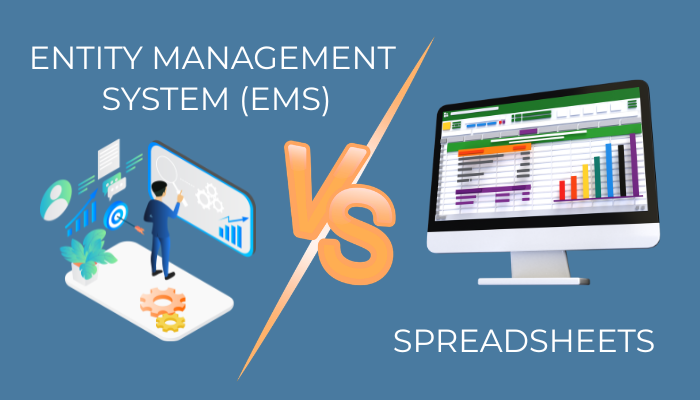
An Entity Management System (EMS) is a dedicated software platform that centralizes a company’s corporate record — directors, shareholders, licenses, filings, and governing documents — into a single, auditable source of truth. Organizations typically adopt one when spreadsheet-based tracking starts producing missed filing deadlines, conflicting data versions, or governance blind spots across multiple entities and jurisdictions.
Why Spreadsheets Break Down as You Grow
Every company starts somewhere simple: one entity, one spreadsheet, one person who “knows where everything is.” That works — until it doesn’t.
As organizations grow, corporate structure grows with them: new subsidiaries, joint ventures, holding companies, and foreign registrations pile up, often faster than internal processes do. At that point, spreadsheet-based entity tracking becomes a genuine operational risk, not just an inconvenience. The failure modes are predictable and recurring:
Data silos. Legal keeps its own tracker. Finance keeps another. Tax keeps a third. None of them reconcile automatically, and each team ends up asking “which version is correct?” during audits or board requests.
Version confusion. A director resignation or a change in registered address gets updated in one file but not another. Weeks later, a filing goes out with stale information.
Missed deadlines. Annual returns, franchise tax filings, license renewals — each jurisdiction has its own calendar, and spreadsheets have no memory. Nobody gets reminded until the penalty notice arrives.
No audit trail. When a regulator, acquirer, or auditor asks “who approved this and when,” a spreadsheet can’t reconstruct that history — there’s no changelog, no timestamp, no accountability record.
These aren’t hypothetical risks. Missed statutory filings can trigger late penalties, loss of good standing, or even involuntary dissolution in some jurisdictions — and losing good standing can complicate financing rounds, M&A due diligence, and banking relationships at the worst possible time.
What Is an Entity Management System (EMS)?
An Entity Management System is a software platform purpose-built to manage the corporate record — the complete, authoritative set of data and documents that define how each legal entity in a group is structured, owned, and governed. Rather than living across disconnected spreadsheets and shared drives, this data lives in one system that legal, tax, finance, and compliance teams all draw from.
At its core, an EMS answers questions that should be simple but often aren’t in a spreadsheet-based setup: Who are the current directors of our Singapore subsidiary? When does our license in Brazil expire? Who owns what percentage of our German entity, and has that changed in the last two years?
Key Benefits of Adopting an EMS
Centralized Data
Legal, tax, and finance teams get instant, shared access to organizational charts, entity details, and ownership structures — instead of requesting an update from whoever last touched the spreadsheet. This matters most during time-sensitive events: financing rounds, restructurings, or regulatory inquiries, where “we’ll get back to you” isn’t an acceptable answer.
Automated Alerts
Filing deadlines, license renewals, and director term expirations are tracked automatically, with notifications sent ahead of time — not discovered after a penalty notice arrives. This shifts compliance from reactive (responding to problems) to proactive (preventing them).
Document Repository
Articles of incorporation, bylaws, board minutes, share certificates, and powers of attorney are stored securely in one place, linked directly to the entity they belong to. When due diligence requests come in during an acquisition or financing round, documents are retrievable in minutes instead of days.
Reporting
Complex reports — ownership structures, director appointments, entity charts by jurisdiction — can be generated in seconds rather than reconstructed manually. This is particularly valuable for board reporting, regulatory disclosures, and beneficial ownership reporting requirements, which increasingly demand exactly this kind of structured output.
Spreadsheets vs. an EMS: A Side-by-Side Comparison
Factor
Spreadsheets
Entity Management System
Single source of truth
No — multiple versions across teams
Yes — one authoritative record
Deadline tracking
Manual, memory-dependent
Automated alerts
Audit trail
None or minimal
Full change history
Document storage
Scattered across drives/email
Centralized, linked to each entity
Reporting speed
Hours to days (manual compilation)
Minutes (generated on demand)
Access control
Difficult to manage/restrict
Role-based permissions
Scales with entity count
Poorly — risk compounds with each new entity
Designed for multi-entity, multi-jurisdiction structures
When Should a Company Adopt an EMS?
There’s no fixed headcount or entity-count threshold, but a few signals reliably indicate it’s time:
You’ve crossed roughly 5–10 legal entities, especially across more than one jurisdiction
You’ve had at least one missed filing or late-penalty incident in the past 12 months
More than one team maintains its own version of entity data
You’re preparing for financing, an acquisition, or an IPO, where due diligence will scrutinize your corporate record directly
Your beneficial ownership or governance reporting obligations have expanded (a trend accelerating globally as regulators demand more transparency into corporate structures)
Frequently Asked Questions
What’s the difference between an EMS and a document management system? A general document management system stores files. An EMS is purpose-built around legal entities as the organizing structure — every document, deadline, and data point is linked to a specific entity, director, or filing obligation, not just stored in a folder.
Does an EMS replace legal counsel or a corporate services provider? No. An EMS is the system of record; it doesn’t file documents with regulators or provide legal advice on its own. Many organizations pair an EMS with managed compliance services so the platform stays current without internal teams handling data entry themselves.
How does an EMS help during M&A or fundraising due diligence? Due diligence requests typically ask for cap tables, director histories, good-standing certificates, and governing documents across every entity in the group. With an EMS, these are already centralized and exportable, which can meaningfully shorten diligence timelines compared to reconstructing records from spreadsheets and email threads.
Is an EMS only useful for large multinational companies? No — the tipping point is entity complexity, not company size. A mid-sized company with five subsidiaries across three countries faces the same version-control and deadline risks as a much larger company, just at a smaller scale.
How CORPIYA Helps
CORPIYA provides a state-of-the-art Entity Management System tailored for global businesses. Our platform integrates seamlessly with our managed services, meaning our team keeps your data updated for you — so you get the transparency and control of a digital platform without the administrative burden of data entry.
Planning to digitize your corporate records? Reach out to us at contact@corpiya.com to discuss how we can support your next steps.
More Entity Management System Questions, Answered
What is AI-driven corporate governance?
AI-driven corporate governance uses automation and machine learning to monitor filing deadlines, flag compliance gaps, and keep entity data accurate across a group’s structure, reducing the manual tracking that causes missed deadlines and version confusion. It shifts governance from reactive spreadsheet management to proactive, system-driven oversight.
How can AI improve entity management?
AI can automatically flag upcoming filing deadlines, detect inconsistencies between records, and surface entities approaching a compliance risk before it becomes a penalty. Paired with an Entity Management System, this turns a static corporate record into an actively monitored one.
How do companies automate corporate compliance?
Companies automate compliance by centralizing entity data, filing deadlines, and governing documents in a single Entity Management System, then layering automated alerts on top so obligations are tracked without relying on memory or a spreadsheet owner. Many organizations also pair the platform with managed compliance services so the underlying data stays current.
How can technology help manage global subsidiaries?
An Entity Management System gives legal, tax, and finance teams shared, real-time access to each subsidiary’s directors, ownership, licenses, and filing status instead of reconstructing that information from scattered files. This is especially valuable during financing rounds, restructurings, or regulatory inquiries, when answers need to be immediate.
How do I track entity compliance across multiple jurisdictions?
The most reliable way is a dedicated Entity Management System that links every filing deadline, license renewal, and governing document to the specific entity and jurisdiction it belongs to, with automated alerts ahead of each deadline. Once a company crosses roughly five to ten legal entities across more than one jurisdiction, spreadsheet-based tracking reliably starts to break down.
Disclaimer: This article is provided for general informational purposes only and does not constitute legal advice. Sebastien Gaddini is licensed to practice law in New York; this piece addresses business-expansion and compliance topics in a non-legal, informational capacity and should not be relied upon as legal counsel. For advice specific to your situation, consult a qualified attorney licensed in the relevant jurisdiction.
Put These Insights Into Action
Talk to our team about how this applies to your operations — wherever your business takes you, Corpiya is ready to support your next move.