
Brazil’s 2026 Tax Reform: What Multinational Companies Must Do Now

Brazil's 2026 Tax Reform: What Multinational Companies Must Do Now

Brazil’s Tax Reform Is Exposing a Hidden Problem in Multinational Companies.
And it has nothing to do with tax calculation.
Brazil’s most significant tax overhaul in decades is no longer on the horizon — it is actively underway. The dual VAT reform replacing multiple legacy indirect taxes with two new frameworks, the Contribuição sobre Bens e Serviços (CBS) and the Imposto sobre Bens e Serviços (IBS), entered its implementation phase in 2026 and will run through a transition period ending in 2033.

For multinational corporations with operations, subsidiaries, or supply chain relationships in Brazil, the clock is no longer ticking. It has already started counting down.

But the most urgent challenge facing companies right now is not tax calculation. It is organizational visibility — knowing where compliance-critical information lives across legal, finance, payroll, and local country teams before regulators come asking for it.

What Is Brazil’s Dual VAT Reform (CBS + IBS)?

Brazil’s tax reform consolidates a historically fragmented indirect tax system — including PIS, COFINS, ICMS, ISS, and IPI — into a cleaner dual-VAT structure:

  • CBS (Contribuição sobre Bens e Serviços): A federal-level contribution replacing PIS and COFINS

  • IBS (Imposto sobre Bens e Serviços): A state and municipal-level tax replacing ICMS and ISS

The transition is phased between 2026 and 2033, with companies expected to operate under both legacy and new systems simultaneously during much of that window. Regulators are increasingly requiring centralized, auditable data trails across entities — not just accurate tax filings, but documented evidence of how compliance decisions were made and who was responsible for them.

Why This Reform Is Operationally Critical Right Now

The “Dual Running” Problem

During the transition period, businesses must maintain compliance under both the old and new tax frameworks simultaneously. This creates double the reporting obligations, double the risk of inconsistency, and double the demand on internal teams — most of whom were not built to manage this kind of parallel operation.

Fragmented Information Across Teams Is the Real Risk

Here is the hidden problem that Brazil’s reform is exposing: in most multinationals, compliance information is not centralized. Tax data lives in one system. Legal entity records live in another. Payroll obligations are managed locally. Finance reports upward through a separate structure entirely.

When Brazilian regulators request an auditable data trail — and they increasingly will — companies scramble. Not because the information does not exist, but because no one has a single, reliable view of it.

ERP and Invoicing Systems Are Not Ready

Many companies operating in Brazil are running ERP or invoicing configurations that predate this reform by a decade or more. The new CBS/IBS framework requires updated tax codes, new invoice fields, and different reporting formats. Legacy systems require significant remediation before they can produce compliant output under the new rules.

The 7 Operational Pressure Points of Brazil’s Tax Transition

Companies navigating this reform are finding pressure in the following areas. Use this as a readiness checklist:

  1. Multi-entity compliance coordination — Are all Brazilian subsidiaries and branches filing consistently under the transition rules?

  2. ERP and EMS integration — Have your enterprise systems been updated to support CBS/IBS tax codes and invoice formats?

  3. Invoicing system compliance — Are electronic invoices (NF-e, NFS-e) being generated correctly under the new framework?

  4. Treasury and accounting alignment — Has cash flow modeling been updated to reflect CBS/IBS timing and offset rules?

  5. Indirect tax mapping — Have all products and services been re-categorized under the new tax classification system?

  6. Corporate restructuring review — Does your current Brazil entity structure still make sense under the new tax regime?

  7. Entity-level reporting consistency — Can you produce a consistent, auditable compliance record across all Brazilian entities on demand?

If the answer to any of these is “not yet” or “we are not sure,” your organization is in a position that is increasingly common — and increasingly risky.

What Regulators Are Now Expecting From Multinationals

Brazilian tax authorities are not simply asking companies to file correctly. The direction of regulatory pressure in 2026 is toward:

  • Centralized and auditable entity data that can be produced quickly upon request

  • Demonstrated organizational readiness, not just point-in-time compliance

  • Cross-entity consistency, particularly for multinationals operating through multiple Brazilian legal entities

This shifts the compliance burden from a tax function problem to an enterprise-wide organizational problem. Finance, legal, operations, and local country teams all need to be working from the same information — and that information needs to be accessible, current, and verifiable.

Frequently Asked Questions: Brazil’s 2026 Tax Reform

  • What taxes are being replaced by Brazil’s CBS and IBS? The reform replaces PIS, COFINS, ICMS, ISS, and IPI with two new taxes: the federal CBS and the state/municipal IBS.

  • When does Brazil’s dual VAT transition end? The transition period runs from 2026 through 2033. Companies will operate under both old and new frameworks simultaneously during much of this period.

  • What is the biggest compliance risk for multinationals during the transition? Fragmented information across legal, finance, payroll, and local teams. Regulators expect centralized, auditable data trails — and most multinationals are not currently structured to produce them quickly.

  • Do ERP systems need to be updated for Brazil’s tax reform? Yes. Most legacy ERP and invoicing systems require updates to support new CBS/IBS tax codes, invoice fields, and reporting formats required under the new framework.

  • What should multinationals do now to prepare for Brazil’s tax reform? Conduct an entity-level compliance audit, assess ERP and invoicing system readiness, and establish a centralized view of compliance obligations across all Brazilian entities.

The Bottom Line: Brazil’s Reform Is an Organizational Readiness Test

Brazil’s dual VAT transition is one of the most impactful regulatory shifts affecting multinational corporations operating in Latin America today. The companies that will navigate it successfully are not necessarily those with the most sophisticated tax calculations — they are the ones with the clearest view of their own operations.

Centralized entity data. Aligned teams. Auditable records. These are the competitive advantages that will separate resilient multinationals from reactive ones between now and 2033.

How Corpiya Helps Multinationals Navigate Brazil’s Tax Transition

At Corpiya, we work with multinational corporations to bring clarity and control to exactly this kind of regulatory complexity. Our integrated approach combines Entity Management Solutions (EMS) with Corpiya Advisory Services — giving companies a unified view of compliance obligations, entity structures, and operational data across jurisdictions.

If your organization is facing fragmented information, ERP readiness gaps, or multi-entity coordination challenges ahead of Brazil’s CBS/IBS transition, we can help you build the infrastructure to meet it with confidence.

Get in touch with our team at contact@corpiya.com or visit www.corpiya.com to start the conversation.

Put These Insights Into Action

Talk to our team about how this applies to your operations — wherever your business takes you, Corpiya is ready to support your next move.

Get In Touch

Contact - Send us a message

Related Insights

Back to All Insights

Operational Control in Multi-Entity Businesses: How to Scale Without Losing Visibility

Operational Control in Multi-Entity Businesses: How to Scale Without Losing Visibility

As companies expand across jurisdictions, complexity increases faster than most teams anticipate.

  • New entities are formed.

  • Operations spread across countries.

  • Compliance requirements multiply.

Individually, each component is manageable. Collectively, they create a common problem: Loss of operational control.

This doesn’t happen because of a single failure. It happens gradually — through fragmented systems, disconnected processes, and lack of centralized visibility.

For growing businesses, the real challenge is not expansion. It is maintaining control while scaling.

What Is Operational Control in a Multi-Entity Structure?

Operational control refers to a company’s ability to:

  • maintain visibility across all entities

  • track compliance obligations and deadlines

  • manage legal, financial, and administrative processes consistently

  • ensure alignment between strategy and execution

In a multi-entity environment, this becomes significantly more complex due to:

  • multiple jurisdictions with different regulatory frameworks

  • varying compliance timelines and filing requirements

  • decentralized teams managing different functions

  • fragmented data across systems and providers

Without a structured approach, companies begin to lose clarity over how their organization actually operates.

Why Companies Lose Control as They Scale

Most companies do not plan for operational complexity early enough.

As a result, they rely on:

  • spreadsheets for compliance tracking

  • local advisors operating independently

  • disconnected legal, accounting, and HR processes

  • reactive decision-making instead of structured oversight

This leads to common issues such as:

  • missed filing deadlines

  • inconsistent governance practices

  • lack of real-time visibility across entities

  • delays in decision-making

  • increased regulatory and financial risk

Over time, these inefficiencies compound — especially during audits, fundraising, or expansion into new markets.

The Three Layers of Operational Control

Maintaining control across a multi-entity structure requires alignment across three core layers:

1. Legal Control (Governance & Risk Management)

Legal frameworks define how decisions are made and how risk is managed.

This includes:

  • corporate governance structures

  • contract management and risk allocation

  • regulatory compliance

  • decision-making authority and documentation

Without consistent legal oversight, companies face:

  • unclear accountability

  • contract inconsistencies

  • exposure to regulatory risk

A structured legal approach ensures that governance aligns with how the business actually operates.

2. Corporate Control (Execution & Compliance)

Corporate operations are where strategy is executed.

This includes:

  • company formation and structuring

  • annual compliance and statutory filings

  • accounting and treasury management

  • corporate secretarial and record-keeping

The challenge is not just execution — it is coordination across jurisdictions. Without centralized management, companies often experience:

  • duplicated efforts

  • inconsistent reporting

  • gaps in compliance

  • operational inefficiencies

Corporate control ensures that all entities remain compliant, aligned, and operationally consistent.

3. Technology Control (Visibility & Coordination)

Technology provides the layer that connects everything. A centralized system allows companies to:

  • track compliance obligations in real time

  • manage documents across entities

  • maintain visibility over deadlines and requirements

  • coordinate execution across teams and providers

Without technology, companies rely on manual processes that are difficult to scale. With the right system in place, they gain:

  • real-time visibility

  • improved coordination

  • faster execution

  • reduced risk of oversight

How to Maintain Control While Scaling

To maintain operational control, companies should focus on:

  • Centralization: Bring legal, corporate, and operational data into a unified structure.

  • Standardization: Create consistent processes across entities and jurisdictions.

  • Visibility: Ensure leadership has real-time insight into compliance, operations, and risk.

  • Coordination: Align internal teams and external providers under a single framework.

Operational Control as a Competitive Advantage

Companies that maintain control as they scale are able to:

  • expand into new markets faster

  • respond to regulatory changes more efficiently

  • improve financial and operational performance

  • reduce risk during transactions and audits

In contrast, companies without control often slow down as complexity increases.

How Corpiya Supports Multi-Entity Operations

Corpiya provides an integrated approach to operational control across three pillars:

  • Corpiya Counsel (Legal Services)
    U.S.-based legal support for governance, contracts, and risk management

  • Corpiya Business Services (Corporate Execution)
    Entity setup, compliance, accounting, and administrative operations across jurisdictions

  • Corpiya Tech Services (Entity Management System)
    AI-driven platform providing centralized visibility and coordination across entities

This combined approach allows companies to scale while maintaining structure, visibility, and control.

Conclusion: Control Enables Scalable Growth

Growth introduces complexity. Without structure, that complexity turns into fragmentation — across entities, teams, and jurisdictions.

Operational control is what keeps expansion aligned, visible, and executable. Companies that get this right don’t just grow faster — they operate with clarity, make better decisions, and reduce risk across every layer of the business.

Corpiya brings together legal, corporate, and technology capabilities to support multi-entity operations with structure and oversight.

Explore how Corpiya can support your global operations:
https://corpiya.com

Or contact us directly:
contact@corpiya.com

Put These Insights Into Action

Talk to our team about how this applies to your operations — wherever your business takes you, Corpiya is ready to support your next move.

Get In Touch

Contact - Send us a message

Related Insights

Back to All Insights

Is BPO Still Just About Cost Savings—or a Strategic Growth Engine?

Is BPO Still Just About Cost Savings—or a Strategic Growth Engine?

Business Process Outsourcing (BPO) used to be seen primarily as a way to cut costs. Today, it’s much more than that. With advances in technology, AI, and data analytics, BPO has evolved into a strategic enabler—helping businesses personalize customer interactions, improve efficiency, and drive measurable results.

However, as BPO becomes more sophisticated, the question shifts from whether to outsource to how to outsource strategically. But how can companies leverage BPO strategically without compromising quality, security, or oversight?

From Cost-Cutting to Strategic Impact

BPO is no longer just about moving tasks offshore to save money. Modern companies are using BPO providers to:

  • Deliver personalized customer experiences using AI-powered tools

  • Track and improve key metrics like Net Promoter Score (NPS) and First Contact Resolution (FCR)

  • Ensure compliance with data protection regulations like GDPR and CCPA

  • Free internal teams to focus on high-value, strategic initiatives

But with greater impact comes greater complexity.

Nearshoring and Onshoring: The Strategic Advantage

As data security and oversight become more critical, companies are reconsidering traditional offshore models. Nearshoring (outsourcing to neighboring countries) and onshoring (keeping services in the home country) offer distinct advantages:

  • Better oversight and collaboration: Proximity allows for easier communication and real-time monitoring

  • Time-zone alignment: Teams can work alongside internal staff for faster problem resolution

  • Cultural alignment: Shared business norms and language fluency enhance service quality

  • Data protection: Stronger control over sensitive information reduces risk

This shift shows that outsourcing is no longer just about labor arbitrage—it’s about control, quality, and strategic fit. By carefully choosing the location of outsourced operations, businesses can combine cost efficiency with operational security and high-quality service.

Modern BPO as a Strategic Advantage

BPO today goes far beyond handling routine tasks—it drives measurable business results. Companies are using outsourcing to respond faster, resolve issues on the first contact (FCR), and track customer satisfaction through metrics like Net Promoter Score (NPS).

Advanced AI and data analytics enable providers to predict customer needs, optimize processes, and personalize interactions at scale—reducing errors and costs while improving service quality.

Paired with nearshoring or onshoring, BPO becomes scalable, secure, and strategically aligned, transforming outsourcing into a competitive advantage. This combination also lays the foundation for value-based contracts focused on measurable outcomes.

How Corpiya Makes BPO Strategic and Seamless

Corpiya helps businesses use BPO as a growth tool, not just a way to cut costs. Our approach blends people, processes, and technology—ensuring every outsourced function supports your larger strategy. We combine AI-powered customer service, secure processes, and flexible solutions so your team can focus on what matters most.

With Corpiya, your operations stay aligned, your data stays protected, and your customer experience continuously improves—all while scaling intelligently.

Ready to transform your operations? Contact Corpiya today with the form below or at info@corpiya.com.

Put These Insights Into Action

Talk to our team about how this applies to your operations — wherever your business takes you, Corpiya is ready to support your next move.

Get In Touch

Contact - Send us a message

Related Insights

Back to All Insights

Is Your Technology Holding Back Global Growth?

Is Your Technology Holding Back Global Growth?

Expanding globally is exciting—but without the right technology in place, scaling can quickly turn into a struggle.

An EMS is a software platform dedicated to managing the corporate record. It serves as a single source of truth for all entity-related data and documents.

Key Challenges

As businesses grow across markets, many face the same challenges:

  • Outdated systems that can’t support new workflows

  • Disconnected data and slow integrations between platforms

  • Manual processes draining time and resources

  • Limited visibility across global operations

  • Security and compliance risks that increase with every new location

The right technology can turn these challenges into opportunities—but getting there requires more than just buying software. It’s about building an ecosystem that’s efficient, secure, and aligned with your business goals.

Why Scalable IT Matters for Global Businesses

In today’s digital-first world, every company is a technology company. Whether you’re managing international teams, optimizing operations, or expanding into new markets, success depends on having the right digital infrastructure.

A modern, integrated IT environment enables companies to:

  • Streamline global operations through automation and centralized systems

  • Improve collaboration across regions and teams

  • Strengthen data security and compliance

  • Enhance decision-making with real-time insights

  • Scale faster without adding complexity

When systems talk to each other and processes run seamlessly, technology stops being a bottleneck—and becomes your growth engine.

How Corpiya Technology Services Drives Efficiency and Growth

Corpiya’s technology services help organizations streamline global operations and scale confidently. From system selection to implementation, integration, and ongoing support, we combine deep process expertise with automation and smart design to make technology work for you.

Entity Management System: Where Technology Meets Governance

Managing complex corporate structures can be overwhelming. Corpiya’s AI-driven Entity Management System (EMS) brings structure, automation, and intelligence to governance.

Our unified platform connects data, compliance workflows, and local execution—so your teams can manage entities, filings, and corporate records seamlessly across jurisdictions.

From automated document generation to real-time collaboration and compliance tracking, Corpiya’s EMS transforms governance into a strategic advantage.

Build a Smarter, More Connected Global Operation

Technology should accelerate growth, not slow it down. Whether you need to modernize infrastructure, automate workflows, or manage global entities more efficiently, Corpiya Technology Services delivers the expertise, systems, and support to get you there.

Let’s make your technology work harder—so you can focus on what matters most: growing your business.

Ready to power your global operations with smarter technology?

Contact Corpiya today through the form below or email info@corpiya.com to start building your digital transformation journey.

Put These Insights Into Action

Talk to our team about how this applies to your operations — wherever your business takes you, Corpiya is ready to support your next move.

Get In Touch

Contact - Send us a message

Related Insights

Back to All Insights

Entity Management Systems: Streamlining Corporate Governance

Entity Management Systems: Streamlining Corporate Governance

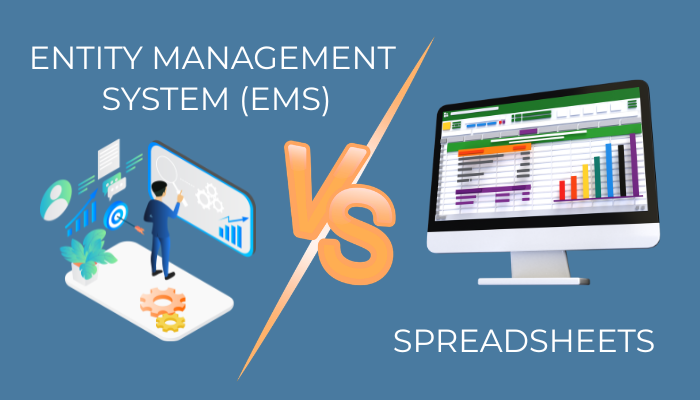
An Entity Management System (EMS) is a dedicated software platform that centralizes a company’s corporate record — directors, shareholders, licenses, filings, and governing documents — into a single, auditable source of truth. Organizations typically adopt one when spreadsheet-based tracking starts producing missed filing deadlines, conflicting data versions, or governance blind spots across multiple entities and jurisdictions.

Why Spreadsheets Break Down as You Grow

Every company starts somewhere simple: one entity, one spreadsheet, one person who “knows where everything is.” That works — until it doesn’t.

As organizations grow, corporate structure grows with them: new subsidiaries, joint ventures, holding companies, and foreign registrations pile up, often faster than internal processes do. At that point, spreadsheet-based entity tracking becomes a genuine operational risk, not just an inconvenience. The failure modes are predictable and recurring:

  • Data silos. Legal keeps its own tracker. Finance keeps another. Tax keeps a third. None of them reconcile automatically, and each team ends up asking “which version is correct?” during audits or board requests.
  • Version confusion. A director resignation or a change in registered address gets updated in one file but not another. Weeks later, a filing goes out with stale information.
  • Missed deadlines. Annual returns, franchise tax filings, license renewals — each jurisdiction has its own calendar, and spreadsheets have no memory. Nobody gets reminded until the penalty notice arrives.
  • No audit trail. When a regulator, acquirer, or auditor asks “who approved this and when,” a spreadsheet can’t reconstruct that history — there’s no changelog, no timestamp, no accountability record.

These aren’t hypothetical risks. Missed statutory filings can trigger late penalties, loss of good standing, or even involuntary dissolution in some jurisdictions — and losing good standing can complicate financing rounds, M&A due diligence, and banking relationships at the worst possible time.

What Is an Entity Management System (EMS)?

An Entity Management System is a software platform purpose-built to manage the corporate record — the complete, authoritative set of data and documents that define how each legal entity in a group is structured, owned, and governed. Rather than living across disconnected spreadsheets and shared drives, this data lives in one system that legal, tax, finance, and compliance teams all draw from.

At its core, an EMS answers questions that should be simple but often aren’t in a spreadsheet-based setup: Who are the current directors of our Singapore subsidiary? When does our license in Brazil expire? Who owns what percentage of our German entity, and has that changed in the last two years?

Key Benefits of Adopting an EMS

Centralized Data

Legal, tax, and finance teams get instant, shared access to organizational charts, entity details, and ownership structures — instead of requesting an update from whoever last touched the spreadsheet. This matters most during time-sensitive events: financing rounds, restructurings, or regulatory inquiries, where “we’ll get back to you” isn’t an acceptable answer.

Automated Alerts

Filing deadlines, license renewals, and director term expirations are tracked automatically, with notifications sent ahead of time — not discovered after a penalty notice arrives. This shifts compliance from reactive (responding to problems) to proactive (preventing them).

Document Repository

Articles of incorporation, bylaws, board minutes, share certificates, and powers of attorney are stored securely in one place, linked directly to the entity they belong to. When due diligence requests come in during an acquisition or financing round, documents are retrievable in minutes instead of days.

Reporting

Complex reports — ownership structures, director appointments, entity charts by jurisdiction — can be generated in seconds rather than reconstructed manually. This is particularly valuable for board reporting, regulatory disclosures, and beneficial ownership reporting requirements, which increasingly demand exactly this kind of structured output.

Spreadsheets vs. an EMS: A Side-by-Side Comparison

Factor Spreadsheets Entity Management System
Single source of truth No — multiple versions across teams Yes — one authoritative record
Deadline tracking Manual, memory-dependent Automated alerts
Audit trail None or minimal Full change history
Document storage Scattered across drives/email Centralized, linked to each entity
Reporting speed Hours to days (manual compilation) Minutes (generated on demand)
Access control Difficult to manage/restrict Role-based permissions
Scales with entity count Poorly — risk compounds with each new entity Designed for multi-entity, multi-jurisdiction structures

When Should a Company Adopt an EMS?

There’s no fixed headcount or entity-count threshold, but a few signals reliably indicate it’s time:

  • You’ve crossed roughly 5–10 legal entities, especially across more than one jurisdiction
  • You’ve had at least one missed filing or late-penalty incident in the past 12 months
  • More than one team maintains its own version of entity data
  • You’re preparing for financing, an acquisition, or an IPO, where due diligence will scrutinize your corporate record directly
  • Your beneficial ownership or governance reporting obligations have expanded (a trend accelerating globally as regulators demand more transparency into corporate structures)

Frequently Asked Questions

What’s the difference between an EMS and a document management system? A general document management system stores files. An EMS is purpose-built around legal entities as the organizing structure — every document, deadline, and data point is linked to a specific entity, director, or filing obligation, not just stored in a folder.

Does an EMS replace legal counsel or a corporate services provider? No. An EMS is the system of record; it doesn’t file documents with regulators or provide legal advice on its own. Many organizations pair an EMS with managed compliance services so the platform stays current without internal teams handling data entry themselves.

How does an EMS help during M&A or fundraising due diligence? Due diligence requests typically ask for cap tables, director histories, good-standing certificates, and governing documents across every entity in the group. With an EMS, these are already centralized and exportable, which can meaningfully shorten diligence timelines compared to reconstructing records from spreadsheets and email threads.

Is an EMS only useful for large multinational companies? No — the tipping point is entity complexity, not company size. A mid-sized company with five subsidiaries across three countries faces the same version-control and deadline risks as a much larger company, just at a smaller scale.

How CORPIYA Helps

CORPIYA provides a state-of-the-art Entity Management System tailored for global businesses. Our platform integrates seamlessly with our managed services, meaning our team keeps your data updated for you — so you get the transparency and control of a digital platform without the administrative burden of data entry.

Planning to digitize your corporate records? Reach out to us at contact@corpiya.com to discuss how we can support your next steps.

Put These Insights Into Action

Talk to our team about how this applies to your operations — wherever your business takes you, Corpiya is ready to support your next move.

Get In Touch

Contact - Send us a message

Related Insights

Back to All Insights