

What Is an LOI in M&A? The Deal’s First Real Blueprint
A letter of intent (LOI) in mergers and acquisitions is a preliminary document that records the main terms of a proposed deal before the parties begin full due diligence and negotiate a definitive purchase agreement.
It usually covers the proposed price, deal structure, payment mix, diligence process, timeline, and exclusivity. Most commercial terms are non-binding, but provisions such as confidentiality, exclusivity, expenses, and governing law may be binding. That distinction matters: an LOI is not the final sale contract, yet it often sets the economic and negotiating boundaries for everything that follows.
For a company managing a cross-border transaction, the LOI is where both sides should identify the terms that can change real value – including debt treatment, working-capital targets, earnouts, escrow, rollover equity, regulatory approvals, and founder obligations. A strong LOI creates momentum without leaving critical terms vague enough to cause price pressure later.
I am Sebastien Gaddini, a Principal on Corpiya’s Executive Committee and an M&A attorney with more than 20 years of experience advising on complex corporate and cross-border transactions. Understanding what is an LOI in M&A helps leaders set clear commercial ground rules before costly diligence, legal drafting, and international execution begin.
What Is an LOI in M&A and How Does It Guide Deals?
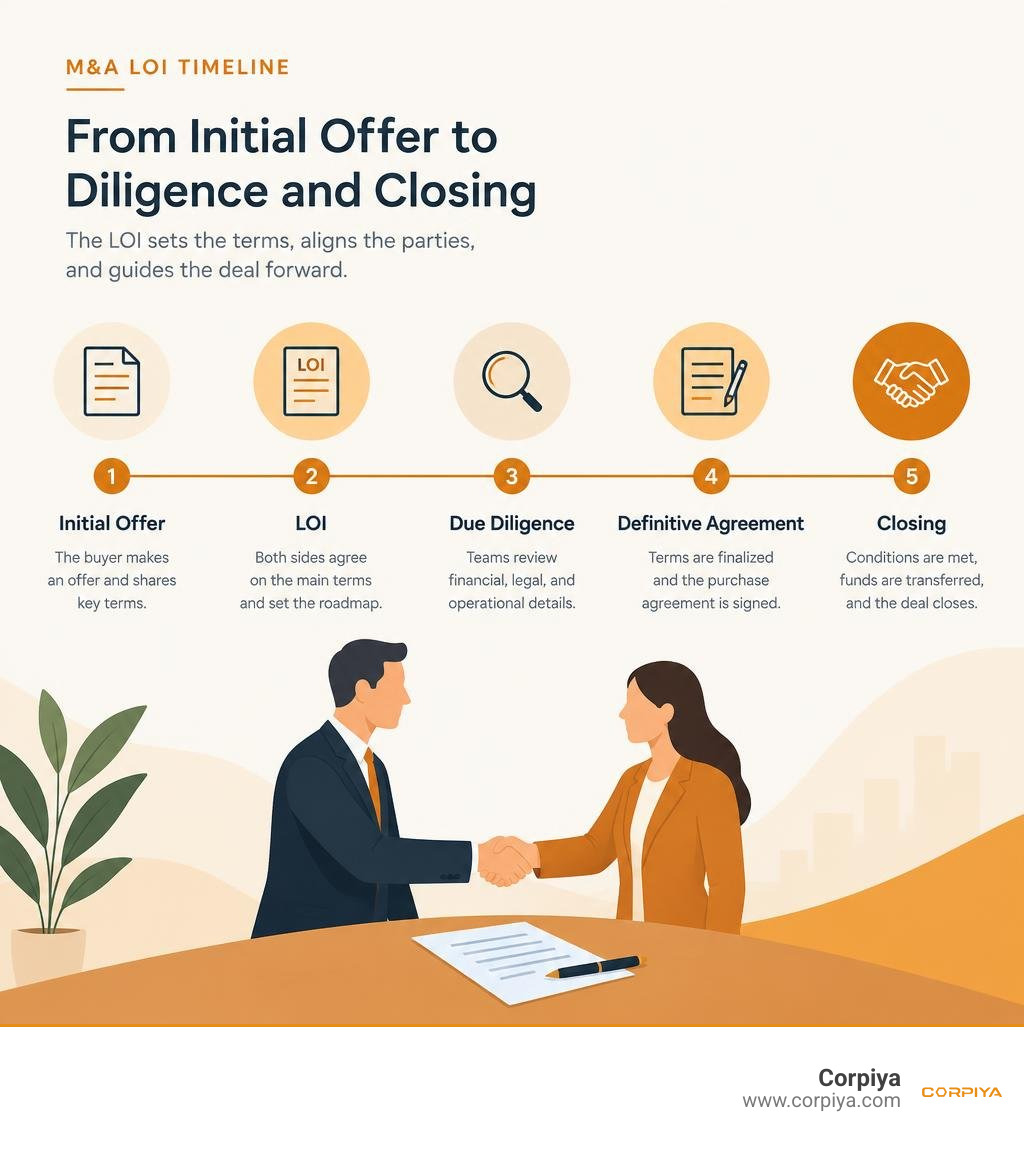
When founders and corporate executives ask us how an acquisition actually gets off the ground, we often describe the letter of intent as the architectural blueprint of the transaction. It is a document typically spanning 3 to 10 pages that transitions a deal from exploratory conversations to an intensive, structured process.
The primary purpose of an LOI is to establish alignment on material commercial and operational items before both sides spend substantial capital on accountants, attorneys, technical auditors, and valuation experts. It locks in the core thesis, creates mutual momentum, and sets a structured roadmap for confirmatory due diligence and definitive drafting. Without an LOI, buyers risk spending hundreds of thousands of dollars investigating a company only to discover fundamentally divergent expectations on deal structure or post-close governance.
As detailed in resources like The LOI Decoded, an LOI is not merely a formality; it is a vital risk-allocation framework where initial economic parameters are defined.
What Is an LOI in M&A Compared to an IOI and Definitive Agreement?
In a competitive or structured M&A process, transactions typically follow a natural progression:
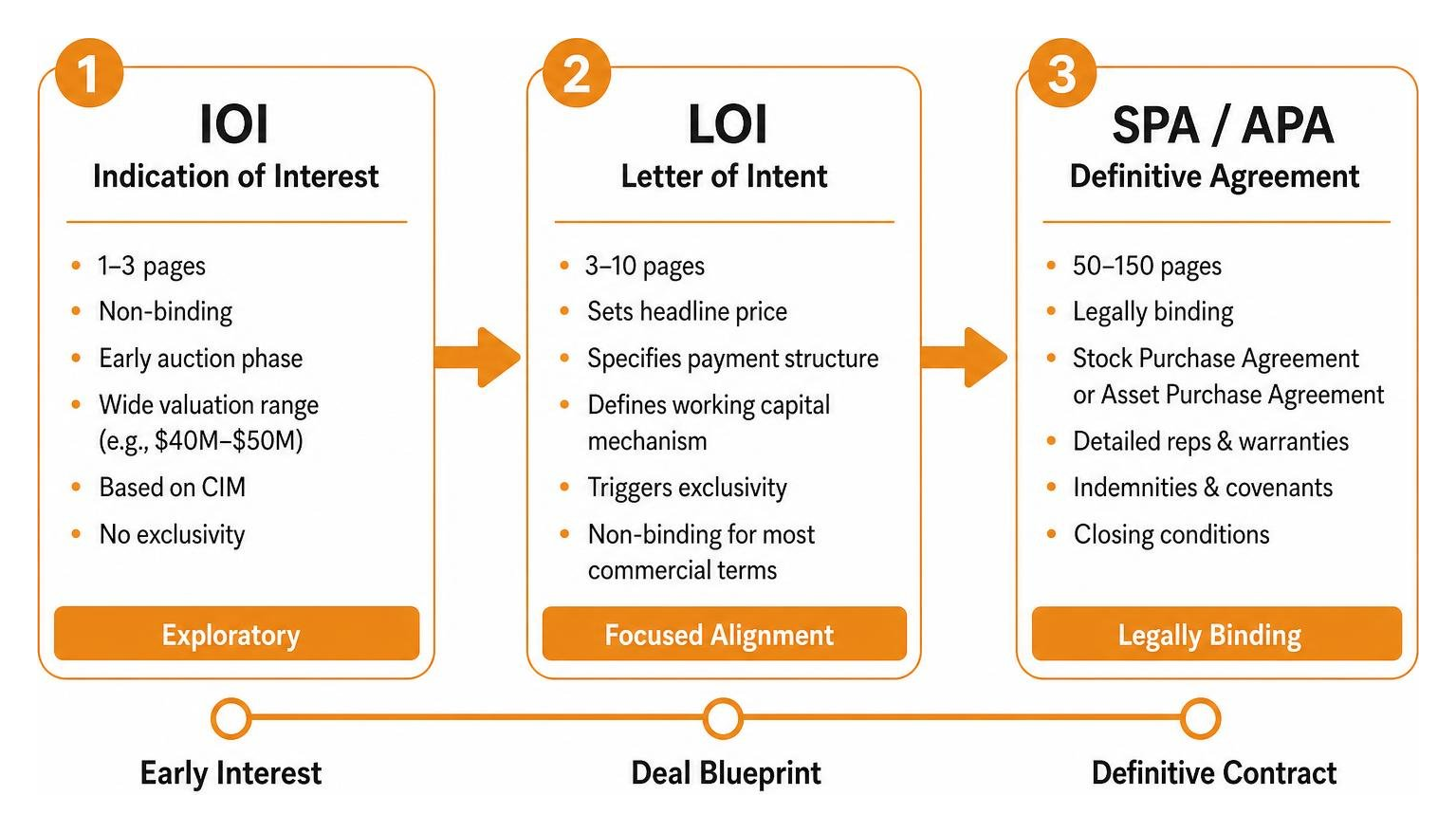
- Indication of Interest (IOI): An informal, 1-to-3-page non-binding letter submitted during the early auction phase. It offers a wide valuation range (e.g., $40M–$50M) based on high-level marketing materials (a Confidential Information Memorandum, or CIM) and does not grant exclusivity.
- Letter of Intent (LOI): Submitted after management presentations and preliminary vetting. It specifies a narrow headline purchase price, concrete payment structures, working capital mechanisms, and crucially, triggers an exclusivity period for the buyer.
- Definitive Purchase Agreement (SPA / APA): The comprehensive, legally binding 50-to-150-page contract (Stock Purchase Agreement or Asset Purchase Agreement) that contains exhaustive representations, warranties, indemnification schemes, covenants, and closing conditions.
To highlight the distinctions across these core documents:
| Feature / Dimension | Indication of Interest (IOI) | Letter of Intent (LOI) | Definitive Agreement (SPA/APA) |
|---|---|---|---|
| Stage in Deal | Early marketing / Round 1 bids | Mid-process / Round 2 selection | Final closing stage |
| Typical Length | 1–3 pages | 3–10 pages | 50–150+ pages |
| Pricing Specificity | Broad range (e.g., $45M–$55M) | Precise headline number & formula | Final exact dollar adjustments |
| Exclusivity Included? | No | Yes (typically 30–60 days) | N/A (deal is executed) |
| Due Diligence Depth | High-level financial review | Confirmatory deep dive access | Full disclosures finalized |
| Legal Status | Non-binding | Hybrid (binding process clauses) | Fully legally binding |
As highlighted in Letter of intent M&A: Key terms, Structure, and Negotiation Tips, moving from an indicative offer to a signed LOI fundamentally shifts negotiating leverage from the seller to the buyer.
Legally Binding vs. Non-Binding Provisions
One of the most critical legal nuances in M&A practice is that an LOI is a hybrid instrument. While parties frequently refer to an LOI as “non-binding,” specific procedural covenants become legally enforceable immediately upon signature.
According to legal overviews such as The Basics of an M&A Letter of Intent | WyrickRobbins, failing to clearly bifurcate these sections can create unwanted exposure.
- Exclusivity (No-Shop Clause): The seller agrees not to solicit, encourage, or negotiate competing acquisition proposals with any third party for a designated period (commonly 30 to 60 days).
- Confidentiality: Restricts the public disclosure of deal discussions and protects shared trade secrets, customer lists, and financial records.
- Expense Allocation: Explicitly defines that each party bears its own accounting, advisory, and legal fees regardless of whether the transaction closes, preventing surprise cost-shifting.
- Governing Law and Jurisdiction: Specifies which state or national legal system (e.g., Delaware, New York, England & Wales) governs disputes arising from the LOI’s binding terms.
- Conduct of Business: Requires the target company to operate strictly in the ordinary course of business, preserving customer relationships and preventing unusual distributions or unapproved capital expenditures during exclusivity.
The LOI Value Bridge: Headline Price vs. Realized Net Proceeds

Many first-time sellers celebrate the moment they see an impressive headline enterprise value on an LOI. However, in institutional M&A, the headline enterprise value is merely the starting ceiling of a deal. The actual net cash wire the seller receives at the closing table is governed by the “Value Bridge.”
As explored in Chapter 8: The Anatomy of a B2B SaaS LOI | Discretion Capital, in the $2M to $20M ARR B2B SaaS market, actual cash at close typically represents only 50% to 80% of the headline enterprise value once debt deductions, escrow holdbacks, working capital peg adjustments, and transaction costs are netted out.
Consider a hypothetical mid-market software acquisition with a headline Enterprise Value of $50,000,000 structured on a customary cash-free, debt-free basis:
- Headline Enterprise Value: $50,000,000
- Less: Funded Debt & Debt-Like Items Payoff: ($4,000,000)
- Less: Rollover Equity (15%): ($7,500,000)
- Less: Earnout / Contingent Consideration: ($5,000,000)
- Less: Seller Financing Note (5-Year Term): ($2,500,000)
- Less: Indemnity & Working Capital Escrow Holdback (10%): ($5,000,000)
- Less: Estimated Working Capital Deficit Adjustment: ($500,000)
- Less: Advisory, Legal, and Accounting Transaction Expenses: ($2,000,000)
- Actual Cash Proceeds Wired at Closing: $23,500,000
Without modeling this value bridge at the LOI stage, sellers can face immense disappointment when their gross proceeds are transformed by standard contractual adjustments.
Working Capital Targets and True-Up Mechanics
Working capital adjustments now appear in more than 90% of private-target M&A transactions, up from roughly 50% a decade ago. It is an indispensable mechanism designed to ensure that the buyer acquires an operating business with sufficient liquidity to sustain normal operations post-closing without injecting immediate emergency capital.
However, working capital adjustments account for 50% or more of all post-closing disputes. When adjustments are owed back to buyers, the average working capital adjustment amount is approximately 0.9% of total transaction value—a multi-hundred-thousand-dollar difference on a mid-market deal.
In tech and recurring revenue businesses, deferred revenue is the classic pitfall. As noted in The Tech Deal series – 2. The LOI: what to lock down before the SPA – Van Doorne, deferred revenue represents upfront cash collected from customers for services yet to be delivered. If the LOI is ambiguous, buyers will aggressively classify deferred revenue as a “debt-like liability” (dollar-for-dollar reduction of the purchase price) rather than an ordinary working capital item. Setting clear accounting methodologies and historical averaging (e.g., a 12-month trailing normalized peg) in the LOI is essential to preventing surprise price cuts.
Escrows, Indemnification Caps, and R&W Insurance
To protect buyers against post-closing breaches of representations, undisclosed tax liabilities, or customer litigation, LOIs routinely stipulate an escrow holdback—typically 10% to 15% of the purchase price held by a third-party escrow agent for 12 to 18 months.
However, the rapid maturation of Representations & Warranties (R&W) Insurance has altered this landscape:
- Non-Insured Deals: In transactions without R&W insurance, the median indemnity escrow sits at approximately 9% of the purchase price, with nearly half of deals exceeding 10%.
- Insured Deals: In transactions utilizing buy-side R&W insurance, the median indemnity escrow drops dramatically to just 0.3% of the purchase price, freeing substantial liquidity for the seller at close.
- Adoption Rates: Approximately 64% of private deals referenced R&W insurance in 2025 (rebounding from 55% in 2023).
- Cost Structure: Current R&W policy premiums run roughly 2.5% to 3.0% of the policy limit, with retention deductibles averaging 0.5% of total enterprise value.
Deciding in the LOI who pays the R&W underwriting fee, premium, and surplus lines taxes prevents contentious late-stage disputes during final legal drafting.
Earnout Structures and Post-Close Contingencies
Earnouts bridge valuation expectations between optimistic sellers and conservative buyers by tying a portion of the purchase price to post-close milestones. While conceptually appealing, earnouts carry structural friction:
- Across all completed deals with earnouts (excluding life sciences), earnouts historically pay out approximately 21 cents on the dollar.
- Among the 59% of transactions that paid anything on their earnouts, the median realization was roughly 50 cents on the dollar.
- Earnouts are contested at least 28% of the time, and 17% of deals that achieved a payout required formal renegotiation to avoid protracted litigation.
In 2024, 62% of earnouts used top-line revenue as their primary operational metric, while only 22% relied on EBITDA. Revenue metrics avoid the contentious accounting disputes associated with corporate cost allocations, shared administrative overhead, and integration expenses.
Integration costs alone can range from 1% to 7% of deal value—with 59% of companies reporting spending 6% or more of deal value on post-acquisition operational integration. If an earnout is pegged to net profit or EBITDA, heavy post-acquisition integration spending can unintentionally wipe out a founder’s payout.
Buyer and Seller Strategies for Negotiating an M&A LOI

Negotiating an LOI is a strategic balancing act. The party that understands how information, timing, and structural deal levers interact will consistently protect their balance sheet and commercial objectives.
Buyer Priorities: Securing Exclusivity and Diligence Access
From the acquirer’s perspective, the LOI serves to establish proprietary negotiating rights and minimize risk:
- Securing Robust Exclusivity: Buyers want an uninterrupted window (typically 45 to 60 days, with automatic extension rights tied to regulatory or financing progress) to conduct confirmatory diligence without competing bidders driving up the price.
- Broad Information Access: Securing unfettered access to internal financial records, source code, senior leadership, and key customer contracts.
- Comprehensive Closing Conditions: Ensuring enforceable conditions precedent, including third-party contract consents, board approvals, debt financing contingencies, and the absence of a Material Adverse Effect (MAE).
- Clear Retentions & Post-Close Governance: Setting founder non-compete periods (commonly 3 to 5 years post-close) and retention packages early to prevent talent flight.
Seller Priorities: Protecting Value and Deal Momentum
For sellers, negotiating leverage peaks immediately before signing the LOI. Once exclusivity is granted, competitive tension vanishes, and the buyer assumes greater leverage. Sellers must prioritize:
- Tight, Conditional Exclusivity: Limiting exclusivity to 30–45 days, requiring the buyer to meet specific milestones (such as delivery of the first draft of the acquisition agreement within 21 days) to maintain exclusivity.
- Locking Down Value Bridge Definitions: Defining exact parameters for cash-free/debt-free definitions, working capital targets, deferred revenue treatment, and transaction expense allocation directly in the LOI text.
- Constraining Ordinary Course Covenants: Ensuring interim operating restrictions do not paralyze normal business hiring, capital investments, or sales cycles while waiting for closing.
- Limiting Post-Close Restraints: Narrowing non-compete covenants geographically and functionally so founders are not indefinitely restricted from future entrepreneurial endeavors.
For additional structural guidance on standard transaction frameworks, review Letter of Intent (LOI) | M&A Glossary.
What Is an LOI in M&A Negotiation: Costly Seller Mistakes to Avoid
Over hundreds of corporate transactions, we observe recurring missteps that erode seller value during LOI execution:
- Treating the LOI as an Informal Non-Binding Draft: Assuming that ambiguous terms can simply be “ironed out later in the purchase agreement.” Buyers rarely make economic concessions once exclusivity is active.
- Delayed Virtual Data Room (VDR) Preparation: Entering exclusivity without organized financial reconciliations, tax records, and clean cap tables. Diligence stalls, exclusivity expires, and buyers use delays to renegotiate downward.
- Failing to Model Net Proceeds: Signing a deal based purely on headline Enterprise Value without quantifying escrow holdbacks, tax drag, debt payoffs, and working capital demands.
- Vague Earnout Governance: Agreeing to an earnout without defining post-close operational autonomy, sales force allocation, or protection against intercompany cost-shifting.
- Ignoring Integration Drag: Failing to account for the reality that integration costs frequently scale above 6% of total deal value, shifting the burden onto the target company’s closing working capital balance.
Frequently Asked Questions About M&A Letters of Intent
Is a letter of intent legally enforceable?
An LOI is a hybrid contract. The substantive commercial terms (such as the purchase price, earnout structures, and post-close management roles) are expressly non-binding and subject to the execution of a definitive purchase agreement. However, procedural and protective covenants—specifically exclusivity (no-shop), confidentiality, expense allocation, conduct of business, and governing law—are legally binding and fully enforceable in court upon signature.
How long does an exclusivity period usually last in an LOI?
In mid-market M&A transactions, exclusivity periods typically run between 30 and 60 days. Acquirers often push for 60 to 90 days to accommodate in-depth quality of earnings (QoE) analyses, technical scans, and financing approvals. Sellers should aim for 30 to 45 days, incorporating milestone-based extensions (e.g., granting a 15-day extension only if the buyer delivers the primary definitive purchase agreement draft within 30 days).
Who is responsible for drafting the LOI?
The buyer’s corporate development team or legal counsel almost always drafts the initial version of the LOI, framing the deal terms, closing conditions, and exclusivity scope from their perspective. The seller and their M&A advisors then mark up and negotiate the document through iterative redlines before signing.
Conclusion
A well-crafted letter of intent establishes strategic alignment, provides a clear transaction blueprint, and mitigates post-closing disputes long before definitive contracts are drawn. Understanding how value moves between headline numbers, working capital targets, escrow holdbacks, and earnouts enables corporate leaders to preserve their leverage throughout the deal lifecycle.
At Corpiya, our AI-powered business services, subscription legal counsel, and unified entity-management platform provide high-growth companies with the cross-border legal infrastructure and transactional precision needed to execute acquisitions seamlessly. To explore how your team can navigate the subsequent stages of the transaction lifecycle after signing your LOI, explore our deep dive on the key legal steps from LOI to closing.