

Defining the Modern Role of Freelance Legal Counsel
To build a flexible legal consulting career, start by mastering core commercial competencies—contract negotiation, corporate governance, intellectual property protection, and data privacy compliance—then package those skills into predictable monthly retainers or fixed-fee projects, and embed yourself directly in client workflows through tools like Slack, Notion, and GitHub. This approach lets you deliver strategic value without the overhead of a full-time in-house role or the billable-hour pressure of a traditional law firm.
The modern corporate environment demands legal leaders who act as proactive strategic partners rather than reactive gatekeepers. Independent practitioners who step into these advisory roles must bridge high-level corporate strategy with ground-level operational execution. When serving as freelance legal counsel, attorneys do not merely redline documents in isolation; they actively participate in executive decision-making, evaluate operational risk tolerances, and establish legal infrastructure that scales alongside the business.
Many successful practitioners transition from prestigious Big Law environments and high-growth technology companies. For example, experienced corporate attorneys such as Sebastien Gaddini, who brings nearly 16 years of legal practice including over 5 years focused on fractional counsel, demonstrate how blending elite corporate training with in-house agility creates immense value for scaling organizations. This combination of deep technical legal precision and practical business pragmatism allows flexible advisors to resolve complex founder disputes, accelerate negotiations, and guide executive teams through pivotal growth milestones.
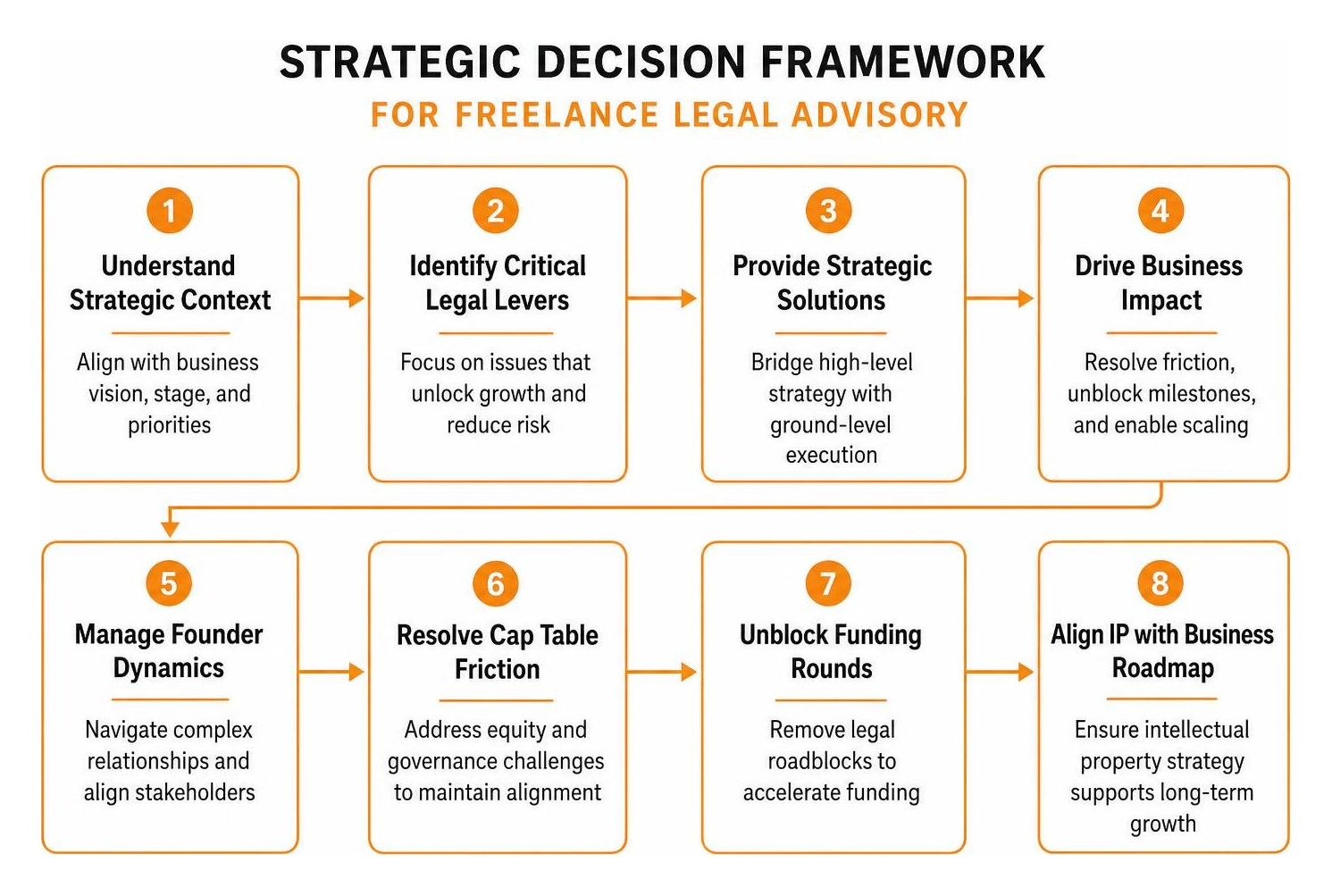
Rather than merely marking up standard agreements, an independent corporate counsel often manages complex founder dynamics, resolves cap table friction, unblocks stalled funding rounds, and aligns intellectual property strategies with business roadmaps.
Comparing Freelance GC to In-House Teams and Law Firms
Building a resilient legal function requires choosing the right delivery model for your current stage of growth. Companies frequently weigh fractional general counsel vs in-house general counsel to balance executive presence against fixed payroll costs.
A traditional law firm operates on an external, transactional model where incentives favor billable hours, often resulting in expensive advice detached from daily business realities. Conversely, a full-time in-house general counsel provides deep alignment but carries substantial overhead—often exceeding $350,000 to $500,000 annually in salary, equity, and benefits.
Independent fractional counsel offers an agile alternative. By embedding directly within leadership channels, fractional advisors deliver deep commercial context at a fraction of full-time executive costs while remaining significantly more integrated than traditional outside law firms.
Essential Core Competencies for Freelance Legal Counsel
To thrive as an independent legal consultant, practitioners must master several high-impact disciplines:
- Commercial Transactions: Structuring, drafting, and negotiating enterprise Master Services Agreements (MSAs), Service Level Agreements (SLAs), vendor contracts, and strategic partnership deals.
- Corporate Governance & Cap Tables: Managing board consents, shareholder voting thresholds, equity incentive plans (ESOPs), and investor rights agreements.
- Intellectual Property Protection: Establishing robust proprietary information and inventions agreements (PIIAs), trademark portfolios, trade secret protocols, and licensing frameworks.
- Data Privacy & Tech Compliance: Structuring data processing agreements (DPAs), cross-border transfer mechanisms, and compliance programs for regulations like GDPR, CCPA/CPRA, and emerging artificial intelligence mandates.
Structuring High-Value Legal Services and Pricing Models

Moving away from the traditional billable hour is the cornerstone of building a modern legal consulting practice. Clients increasingly demand cost predictability, while consultants benefit from recurring, value-based revenue streams. To build a flexible freelance legal counsel career, structure your services around monthly subscriptions for ongoing advisory work and fixed-fee packages for discrete transactions, which gives clients budget certainty and gives you stable cash flow.
Traditional hourly billing creates misaligned incentives between clients and practitioners: clients hesitate to ask critical early-stage questions for fear of the ticking clock, while lawyers are penalized financially for working efficiently. Transitioning to transparent, value-oriented packages unlocks genuine strategic collaboration.
Monthly Subscriptions Versus Project-Based Billing
Choosing subscription legal services vs hourly billing creates financial clarity for both client and consultant.
Monthly subscriptions align incentives: the lawyer focuses on process efficiency, standardizing templates, and preventing disputes, while the client feels empowered to seek quick advice without fearing unpredictable invoices. Fixed-fee project pricing works best for discrete transactions, such as restructuring corporate entities, drafting core customer agreements, or running fundraising due diligence.
Structuring Fees for Growth-Stage and AI Startups
When designing fee structures for early-stage and AI-driven companies, legal consultants must remain flexible:
- Tiered Retainers: Baseline tiers starting at $5,000 per month covering weekly office hours, contract triage, and governance, scaling upward as commercial volume increases.
- Hybrid Cash and Equity: For cash-constrained seed companies with strong upside, accepting a discounted monthly cash retainer paired with advisory equity shares can align long-term incentives.
- Productized Deliverables: Packaged audits—such as AI regulatory readiness assessments or comprehensive IP ownership sweeps—offered at fixed prices (e.g., $1,000 to $3,500) provide low-friction entry points for new clients.
- Strategic Transaction Add-Ons: Clear project-based fee addendums for major corporate financing rounds or complex commercial licensing partnerships that fall outside monthly retainer limits.
Navigating Modern AI Governance and Tech-Driven Practice

In 2026, tech-forward legal advisors must understand the technical foundations of modern software, including modern continuous deployment cycles and AI tooling. Clients want lawyers who can interpret technical nuances directly rather than relying on abstract legal concepts. For a freelance legal counsel career, this means using AI to accelerate draft reviews, automate repetitive redlines, and perform rapid regulatory comparisons, then passing those speed and cost efficiencies directly to clients.
Modern legal practitioners use secure AI environments to accelerate draft reviews, automate repetitive redlines, and perform rapid regulatory comparisons, passing speed and cost efficiencies directly to clients without compromising confidentiality or ethical obligations.
| Workflow Stage | Traditional Legal Process | Modern AI-Augmented Legal Workflow |
|---|---|---|
| Initial Contract Triage | Manual line-by-line reading (3–5 days) | Automated term extraction & risk scoring (<2 hours) |
| Playbook Redlining | Bespoke manual drafting per negotiation | AI-suggested clauses aligned with risk rules |
| Policy Generation | Assembled from static, dated templates | Dynamic drafting calibrated to specific tech stacks |
| Regulatory Tracking | Ad-hoc research across siloed sources | Continuous automated monitoring of global rules |
Managing AI Governance, Data Privacy, and Global Compliance
As governments enforce strict AI and data frameworks, companies face heightened scrutiny:
- EU AI Act Compliance: Classifying AI systems into prohibited, high-risk, or minimal-risk categories, establishing technical documentation, and maintaining human-oversight protocols.
- Global Privacy Standards: Harmonizing operational data workflows across GDPR, UK GDPR, and state-level US regimes (e.g., CPRA).
- Code Provenance and IP Ownership: Reviewing AI-assisted code generation to verify open-source license compatibility and protect downstream copyright enforceability.
- Model Training & Data Usage Agreements: Drafting terms of service and data licensing provisions that clarify whether customer data can be utilized for machine learning model training.
Integrating Freelance Legal Counsel into Fast-Moving Agile Teams
Effective independent counsel integrates smoothly into modern team tools. By joining shared Slack or Teams channels, participating in sprint reviews, and collaborating directly in tools like Notion, GitHub, and Google Workspace, an advisor eliminates communication silos and accelerates commercial velocity.
Scaling, Risk Management, and Client Transitions
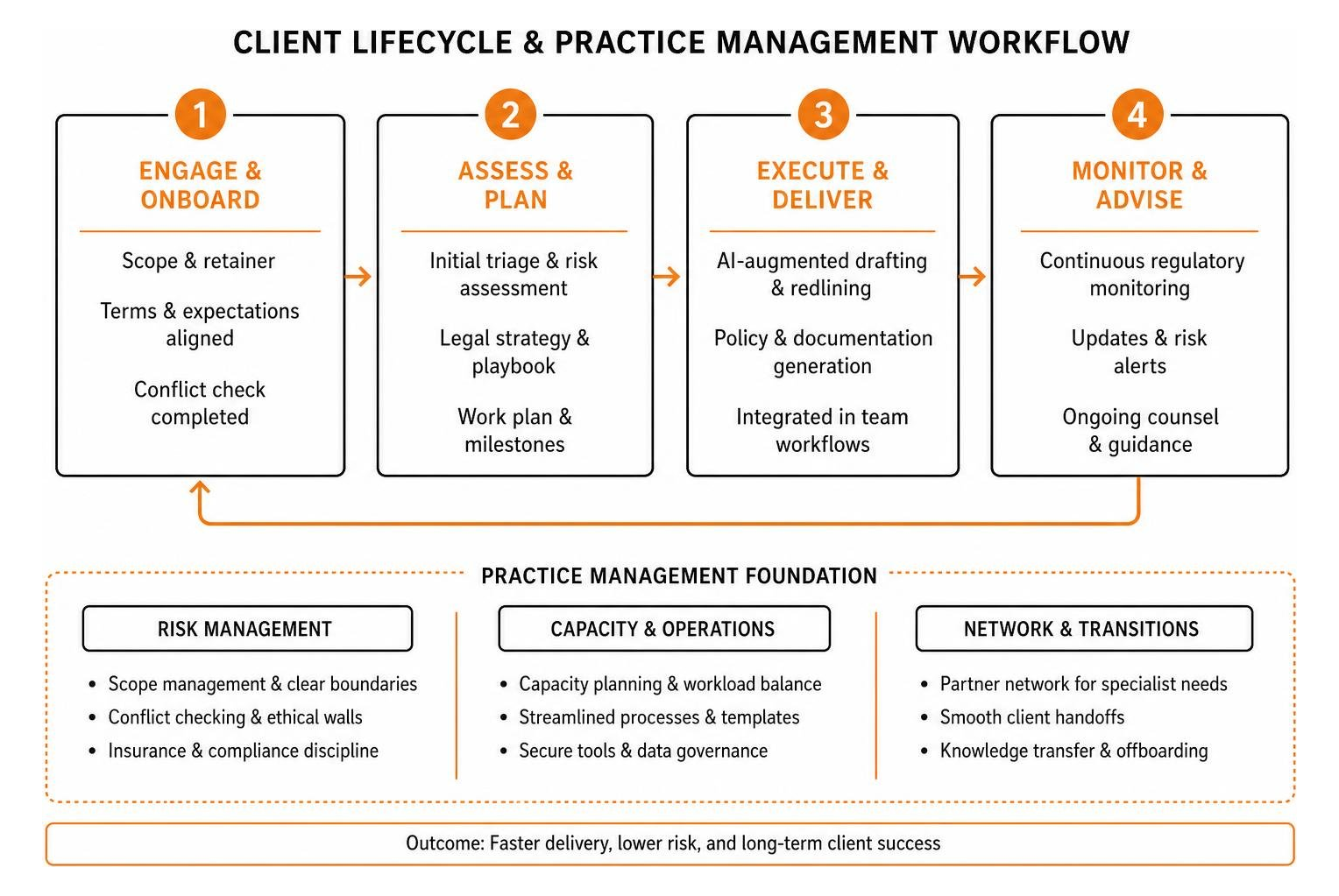
Managing an independent practice requires strict operational discipline to safeguard both your business and your clients. To scale a freelance legal counsel career sustainably, set clear engagement boundaries, implement documented conflict checks, and build a referral network of boutique specialists so you can handle capacity risks without compromising service quality.
Mitigating Common Practice Challenges and Capacity Risks
- Scope Management: Clearly define what is covered under flat monthly retainers versus what constitutes out-of-scope work (e.g., active courtroom litigation or complex cross-border M&A).
- Conflict Checking: Implement rigorous, documented conflict checks before onboarding new clients, maintaining ethical walls when advising companies within adjacent markets.
- Partner Networks: Build relationships with boutique specialists (such as niche tax practitioners, immigration lawyers, and local international firms) to handle specialized regional needs smoothly.
Guiding the Transition to Full-Time In-House Legal Teams
As client revenue grows and transactional volume accelerates, an organization will eventually outgrow fractional support. A skilled consultant identifies this milestone proactively:
- Recognizing when internal demand consistently exceeds 20 to 25 hours per week.
- Designing the job description and compensation architecture for the incoming full-time General Counsel.
- Organizing corporate records, playbooks, contract templates, and compliance matrices to ensure a seamless leadership handover.
Frequently Asked Questions About Freelance Legal Counsel
How much do fractional and freelance legal counsel typically charge?
Rates vary based on experience, region, and engagement scope. Monthly advisory subscriptions generally range from $5,000 to $25,000 per month. Project-based packages typically range from $1,000 for standard contract reviews to $10,000+ for complex corporate reorganizations.
When should an early-stage startup engage a freelance legal advisor?
Startups should bring on flexible legal counsel before signing customer contracts, hiring employees, or raising institutional capital. Setting up clean cap tables, standardized sales agreements, and sound intellectual property assignments early prevents costly remediation later.
What qualifications should businesses look for in an independent legal consultant?
Look for attorneys with a proven combination of tier-one law firm training and direct in-house operational experience. Strong candidates demonstrate commercial acumen, deep familiarity with modern software and AI workflows, and practical problem-solving skills tailored to growth-stage companies.
Conclusion
Building a sustainable career as an independent legal consultant allows experienced practitioners to deliver high-impact advisory work while retaining professional autonomy. By leveraging flexible pricing, embracing modern AI-enabled workflows, and embedding directly into executive teams, independent legal advisors provide the strategic clarity fast-growing companies need.
For growing businesses seeking integrated governance, corporate structuring, and cross-border expansion services, explore how our team delivers corporate advisory and entity management to help your organization scale seamlessly across global markets.