

The Practical Guide to Building a Flexible Legal Consulting Career

Legal advisor collaborating with startup founders

To build a flexible legal consulting career, start by mastering core commercial competencies—contract negotiation, corporate governance, intellectual property protection, and data privacy compliance—then package those skills into predictable monthly retainers or fixed-fee projects, and embed yourself directly in client workflows through tools like Slack, Notion, and GitHub. This approach lets you deliver strategic value without the overhead of a full-time in-house role or the billable-hour pressure of a traditional law firm.

The modern corporate environment demands legal leaders who act as proactive strategic partners rather than reactive gatekeepers. Independent practitioners who step into these advisory roles must bridge high-level corporate strategy with ground-level operational execution. When serving as freelance legal counsel, attorneys do not merely redline documents in isolation; they actively participate in executive decision-making, evaluate operational risk tolerances, and establish legal infrastructure that scales alongside the business.

Many successful practitioners transition from prestigious Big Law environments and high-growth technology companies. For example, experienced corporate attorneys such as Sebastien Gaddini, who brings nearly 16 years of legal practice including over 5 years focused on fractional counsel, demonstrate how blending elite corporate training with in-house agility creates immense value for scaling organizations. This combination of deep technical legal precision and practical business pragmatism allows flexible advisors to resolve complex founder disputes, accelerate negotiations, and guide executive teams through pivotal growth milestones.

Rather than merely marking up standard agreements, an independent corporate counsel often manages complex founder dynamics, resolves cap table friction, unblocks stalled funding rounds, and aligns intellectual property strategies with business roadmaps.
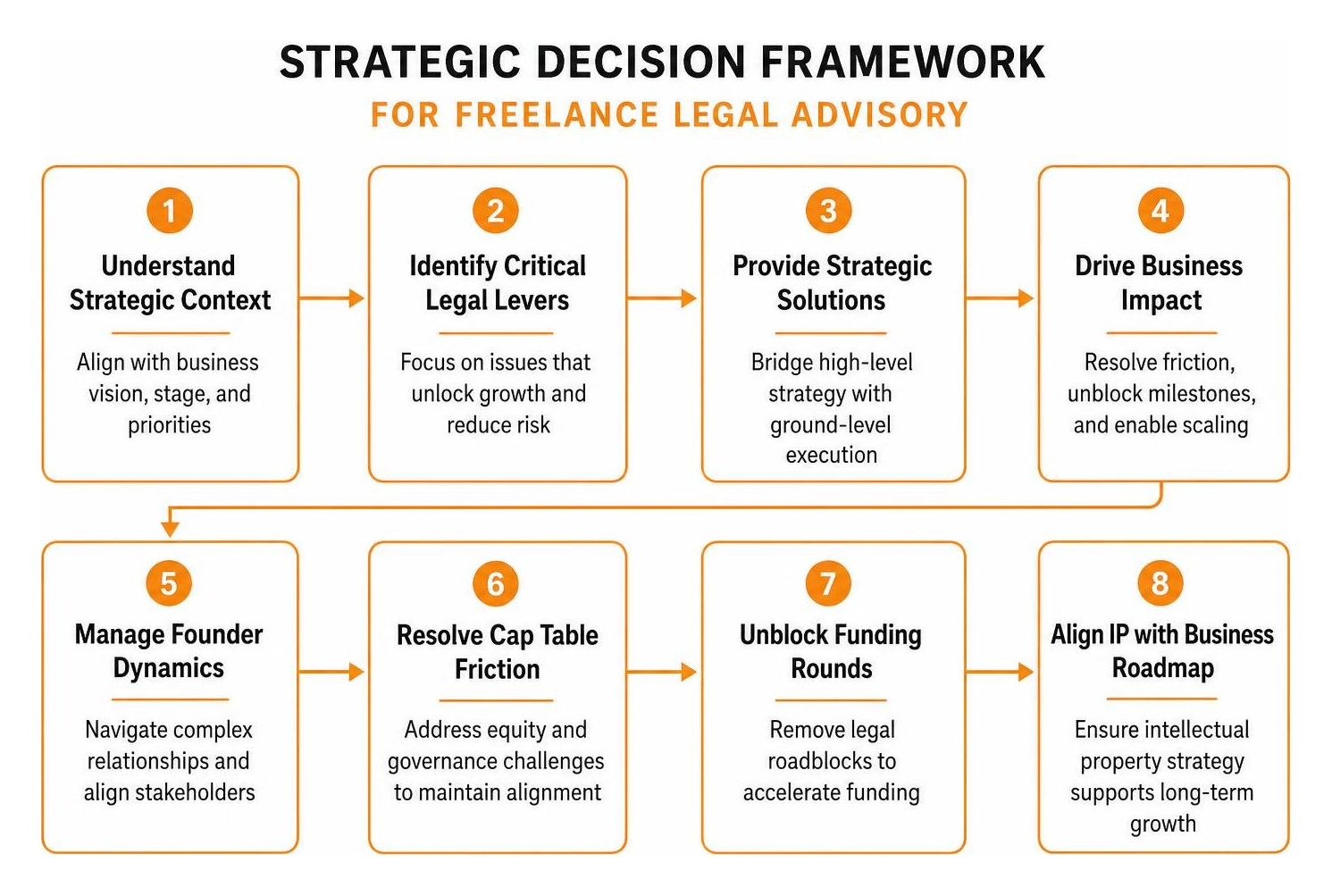
Strategic decision framework for freelance legal advisory

Comparing Freelance GC to In-House Teams and Law Firms

Building a resilient legal function requires choosing the right delivery model for your current stage of growth. Companies frequently weigh fractional general counsel vs in-house general counsel to balance executive presence against fixed payroll costs.

A traditional law firm operates on an external, transactional model where incentives favor billable hours, often resulting in expensive advice detached from daily business realities. Conversely, a full-time in-house general counsel provides deep alignment but carries substantial overhead—often exceeding $350,000 to $500,000 annually in salary, equity, and benefits.

Independent fractional counsel offers an agile alternative. By embedding directly within leadership channels, fractional advisors deliver deep commercial context at a fraction of full-time executive costs while remaining significantly more integrated than traditional outside law firms.

To thrive as an independent legal consultant, practitioners must master several high-impact disciplines:

  • Commercial Transactions: Structuring, drafting, and negotiating enterprise Master Services Agreements (MSAs), Service Level Agreements (SLAs), vendor contracts, and strategic partnership deals.
  • Corporate Governance & Cap Tables: Managing board consents, shareholder voting thresholds, equity incentive plans (ESOPs), and investor rights agreements.
  • Intellectual Property Protection: Establishing robust proprietary information and inventions agreements (PIIAs), trademark portfolios, trade secret protocols, and licensing frameworks.
  • Data Privacy & Tech Compliance: Structuring data processing agreements (DPAs), cross-border transfer mechanisms, and compliance programs for regulations like GDPR, CCPA/CPRA, and emerging artificial intelligence mandates.

Attorney structuring flexible pricing models

Moving away from the traditional billable hour is the cornerstone of building a modern legal consulting practice. Clients increasingly demand cost predictability, while consultants benefit from recurring, value-based revenue streams. To build a flexible freelance legal counsel career, structure your services around monthly subscriptions for ongoing advisory work and fixed-fee packages for discrete transactions, which gives clients budget certainty and gives you stable cash flow.

Traditional hourly billing creates misaligned incentives between clients and practitioners: clients hesitate to ask critical early-stage questions for fear of the ticking clock, while lawyers are penalized financially for working efficiently. Transitioning to transparent, value-oriented packages unlocks genuine strategic collaboration.

Monthly Subscriptions Versus Project-Based Billing

Choosing subscription legal services vs hourly billing creates financial clarity for both client and consultant.

Monthly subscriptions align incentives: the lawyer focuses on process efficiency, standardizing templates, and preventing disputes, while the client feels empowered to seek quick advice without fearing unpredictable invoices. Fixed-fee project pricing works best for discrete transactions, such as restructuring corporate entities, drafting core customer agreements, or running fundraising due diligence.

Structuring Fees for Growth-Stage and AI Startups

When designing fee structures for early-stage and AI-driven companies, legal consultants must remain flexible:

  1. Tiered Retainers: Baseline tiers starting at $5,000 per month covering weekly office hours, contract triage, and governance, scaling upward as commercial volume increases.
  2. Hybrid Cash and Equity: For cash-constrained seed companies with strong upside, accepting a discounted monthly cash retainer paired with advisory equity shares can align long-term incentives.
  3. Productized Deliverables: Packaged audits—such as AI regulatory readiness assessments or comprehensive IP ownership sweeps—offered at fixed prices (e.g., $1,000 to $3,500) provide low-friction entry points for new clients.
  4. Strategic Transaction Add-Ons: Clear project-based fee addendums for major corporate financing rounds or complex commercial licensing partnerships that fall outside monthly retainer limits.

Lawyer analyzing AI compliance frameworks

In 2026, tech-forward legal advisors must understand the technical foundations of modern software, including modern continuous deployment cycles and AI tooling. Clients want lawyers who can interpret technical nuances directly rather than relying on abstract legal concepts. For a freelance legal counsel career, this means using AI to accelerate draft reviews, automate repetitive redlines, and perform rapid regulatory comparisons, then passing those speed and cost efficiencies directly to clients.

Modern legal practitioners use secure AI environments to accelerate draft reviews, automate repetitive redlines, and perform rapid regulatory comparisons, passing speed and cost efficiencies directly to clients without compromising confidentiality or ethical obligations.

Workflow Stage Traditional Legal Process Modern AI-Augmented Legal Workflow
Initial Contract Triage Manual line-by-line reading (3–5 days) Automated term extraction & risk scoring (<2 hours)
Playbook Redlining Bespoke manual drafting per negotiation AI-suggested clauses aligned with risk rules
Policy Generation Assembled from static, dated templates Dynamic drafting calibrated to specific tech stacks
Regulatory Tracking Ad-hoc research across siloed sources Continuous automated monitoring of global rules

Managing AI Governance, Data Privacy, and Global Compliance

As governments enforce strict AI and data frameworks, companies face heightened scrutiny:

  • EU AI Act Compliance: Classifying AI systems into prohibited, high-risk, or minimal-risk categories, establishing technical documentation, and maintaining human-oversight protocols.
  • Global Privacy Standards: Harmonizing operational data workflows across GDPR, UK GDPR, and state-level US regimes (e.g., CPRA).
  • Code Provenance and IP Ownership: Reviewing AI-assisted code generation to verify open-source license compatibility and protect downstream copyright enforceability.
  • Model Training & Data Usage Agreements: Drafting terms of service and data licensing provisions that clarify whether customer data can be utilized for machine learning model training.

Effective independent counsel integrates smoothly into modern team tools. By joining shared Slack or Teams channels, participating in sprint reviews, and collaborating directly in tools like Notion, GitHub, and Google Workspace, an advisor eliminates communication silos and accelerates commercial velocity.

Scaling, Risk Management, and Client Transitions

Managing an independent practice requires strict operational discipline to safeguard both your business and your clients. To scale a freelance legal counsel career sustainably, set clear engagement boundaries, implement documented conflict checks, and build a referral network of boutique specialists so you can handle capacity risks without compromising service quality.
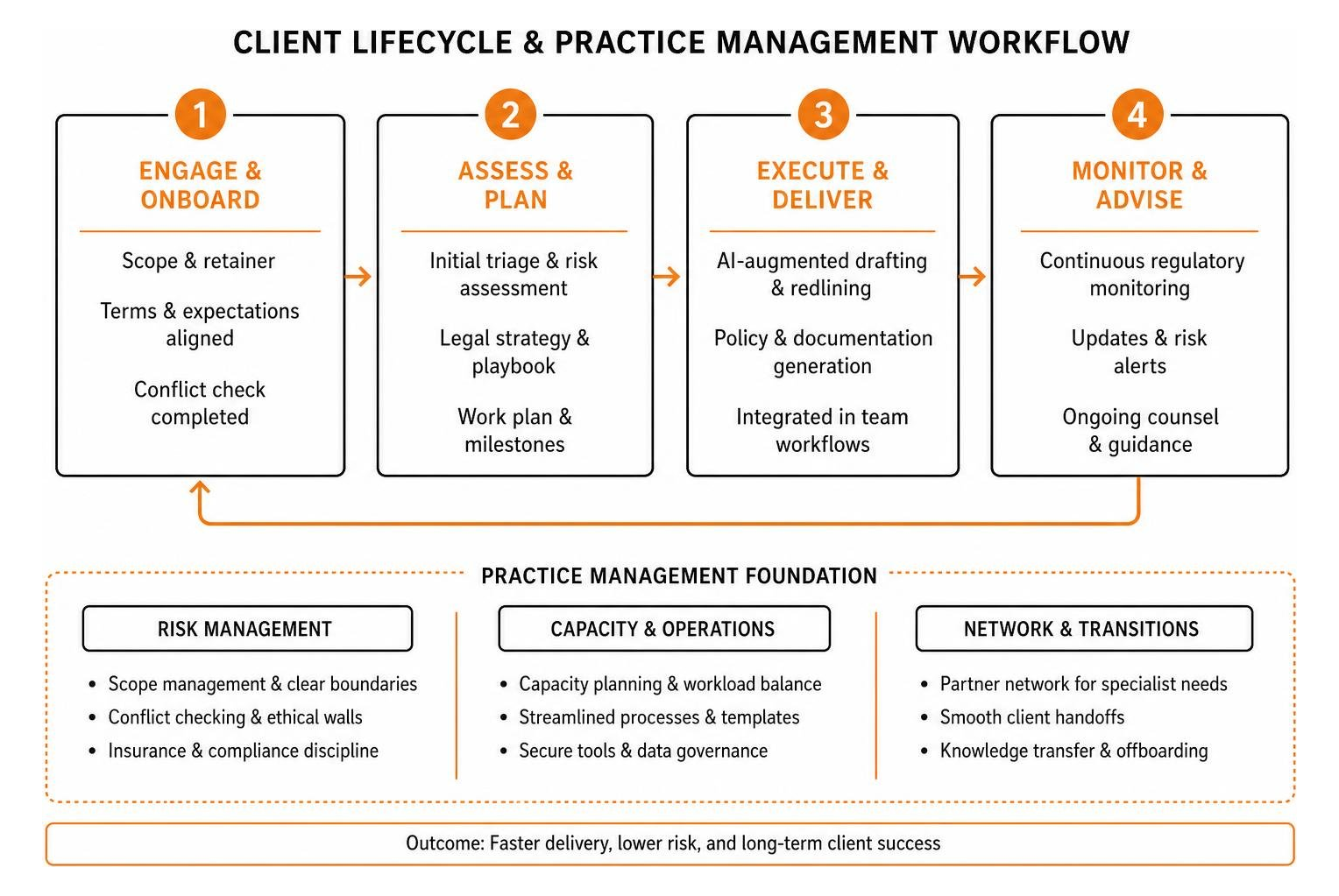
Client lifecycle and practice management workflow

Mitigating Common Practice Challenges and Capacity Risks

  • Scope Management: Clearly define what is covered under flat monthly retainers versus what constitutes out-of-scope work (e.g., active courtroom litigation or complex cross-border M&A).
  • Conflict Checking: Implement rigorous, documented conflict checks before onboarding new clients, maintaining ethical walls when advising companies within adjacent markets.
  • Partner Networks: Build relationships with boutique specialists (such as niche tax practitioners, immigration lawyers, and local international firms) to handle specialized regional needs smoothly.

As client revenue grows and transactional volume accelerates, an organization will eventually outgrow fractional support. A skilled consultant identifies this milestone proactively:

  • Recognizing when internal demand consistently exceeds 20 to 25 hours per week.
  • Designing the job description and compensation architecture for the incoming full-time General Counsel.
  • Organizing corporate records, playbooks, contract templates, and compliance matrices to ensure a seamless leadership handover.

Rates vary based on experience, region, and engagement scope. Monthly advisory subscriptions generally range from $5,000 to $25,000 per month. Project-based packages typically range from $1,000 for standard contract reviews to $10,000+ for complex corporate reorganizations.

Startups should bring on flexible legal counsel before signing customer contracts, hiring employees, or raising institutional capital. Setting up clean cap tables, standardized sales agreements, and sound intellectual property assignments early prevents costly remediation later.

Look for attorneys with a proven combination of tier-one law firm training and direct in-house operational experience. Strong candidates demonstrate commercial acumen, deep familiarity with modern software and AI workflows, and practical problem-solving skills tailored to growth-stage companies.

Conclusion

Building a sustainable career as an independent legal consultant allows experienced practitioners to deliver high-impact advisory work while retaining professional autonomy. By leveraging flexible pricing, embracing modern AI-enabled workflows, and embedding directly into executive teams, independent legal advisors provide the strategic clarity fast-growing companies need.

For growing businesses seeking integrated governance, corporate structuring, and cross-border expansion services, explore how our team delivers corporate advisory and entity management to help your organization scale seamlessly across global markets.


Consult the Office of Corporation Counsel for Municipal Compliance

office of corporation counsel

Why the Office of Corporation Counsel Matters for Municipal Compliance

An Office of Corporation Counsel is the city or county government’s legal department. It advises elected officials and agencies, drafts and reviews ordinances and contracts, helps ensure compliance with state and federal rules, and represents the government in legal disputes.

For a business working with a municipality, this office may affect your project when you need to:

  • Obtain a license, permit, lease, or franchise
  • Negotiate a city contract or development agreement
  • Understand a local ordinance or procurement requirement
  • Respond to an enforcement issue, claim, or administrative hearing

The Corporation Counsel is usually the government’s chief lawyer. Their office works across departments such as finance, planning, public safety, transportation, and real estate. While the exact authority depends on the local charter and code, the core mission is consistent: protect public assets, reduce legal risk, and help government act within the law.

I am Sebastien Gaddini, a Principal on Corpiya’s Executive Committee, with more than 20 years of experience as an M&A attorney and adviser on complex cross-border corporate matters. That work informs my perspective on how an office of corporation counsel approaches governance, contracts, compliance, and public-sector legal risk.

Infographic showing municipal corporation counsel duties: advise, draft, review, defend, enforce infographic

Core Role and Structure of the Office of Corporation Counsel

municipal legal department organizational chart

At its foundation, a municipal corporation counsel operates as the central legal nervous system for local governance. While a private corporate enterprise answers to a board of directors and institutional shareholders, a municipal legal office serves a distinct corporate entity: the municipal corporation itself (the city, town, or county).

Under the statutory framework established by state constitutions and municipal charters, the Corporation Counsel serves as the Chief Legal Officer. In large metropolitan hubs, this office manages legal work comparable to that of international law firms. For example, municipal agencies like the Department of the Corporation Counsel in Honolulu furnish comprehensive legal advice, draft formal opinions, and oversee the municipal charter’s integrity across dozens of local boards, commissions, and operational departments.

To understand how municipal and commercial legal work intersect, it helps to examine how public-sector counsel compares to traditional private in-house counsel:

Feature Municipal Corporation Counsel Private Corporate Counsel
Primary Client The municipal entity (City/County, Mayor, City Council, Agencies) The commercial enterprise (Executives, Board of Directors)
Guiding Mandate Public interest, statutory compliance, municipal code enforcement Shareholder value, commercial growth, enterprise risk management
Governance Framework City Charter, Open Meetings Acts, Public Records Laws (FOIA) Articles of Incorporation, Bylaws, Corporate Governance Codes
Litigation Scope Tort claims, 42 U.S.C. § 1983 civil rights, code enforcement, zoning Commercial contracts, intellectual property, corporate disputes
Authority Origin Statutory or charter appointment by Mayor / confirmation by Council Executive appointment by Chief Executive Officer or Board

Internal Divisions and Departmental Organization

Because municipal governments manage everything from emergency medical services to regional airports, their legal offices are organized into specialized practice groups.

municipal law office divisional structure

A standard municipal legal department typically features several operational divisions:

  • Counseling and Drafting Division: Focuses on legislative drafting, reviewing pending city ordinances, assessing municipal finance structures, and crafting legal opinions for council members.
  • Litigation Division: Defends the municipality against personal injury claims, premises liability, construction disputes, and municipal contract breaches.
  • Land Use and Infrastructure Section: Oversees urban planning, zoning variances, environmental impact reviews, eminent domain proceedings, and commercial real estate acquisitions.
  • Labor, Employment, and Personnel Division: Handles public-sector union negotiations, civil service compliance, employee grievance arbitrations, and workplace safety regulations.
  • Special Operations / Economic Development: Structures public-private partnerships (P3s), municipal bond issuances, and strategic commercial incentives.

While both municipal and private in-house teams handle contracts and dispute resolution, their underlying legal principles differ significantly.

Private enterprises often balance business needs using standard in-house general counsel models or agile outside counsel arrangements. In contrast, municipal attorneys operate within administrative law restrictions, sovereign immunity doctrines, public procurement rules, and strict municipal debt limits.

Every lease, procurement agreement, or municipal settlement approved by a corporation counsel must withstand public scrutiny and comply with municipal ethics codes.

city attorney reviewing municipal contracts and bonds

The day-to-day work of municipal counsel focuses on preventative law. By offering proactive legal advice before a policy is enacted, the office protects the city from costly legal challenges.

Under local statutory frameworks, such as the Indianapolis Code of Ordinances for the Corporation Counsel, the department furnishes all legal services across city-county councils, mayoral offices, and regional divisions. This includes drafting legal instruments, examining real estate titles, and reviewing surety bonds to safeguard public revenue.

Legislative Drafting and Contract Approval

Before a city council votes on a new bill or updates municipal zoning rules, the Corporation Counsel’s drafting division reviews the statutory text. Attorneys verify that proposed measures comply with state enabling statutes and constitutional protections.

Beyond legislative drafting, the office reviews and signs off on every major municipal agreement. Whether managing capital improvement projects, multi-year utility franchises, or digital infrastructure procurement, teams like the Charleston Office of Corporation Counsel ensure agreements follow public bidding rules, include required indemnification clauses, and maintain proper surety bond protections.

Regulatory Compliance and Intergovernmental Coordination

Modern municipalities operate within an intricate web of overlapping county, state, and federal regulations. The Corporation Counsel guides city agencies through this complex regulatory environment:

  1. State Preemption Issues: Determining whether new local ordinances run into conflict with state statutes.
  2. Federal Mandates: Maintaining compliance with federal standards, including the Clean Water Act, Americans with Disabilities Act (ADA), and Fair Labor Standards Act (FLSA).
  3. Intergovernmental Agreements (IGAs): Structuring regional cooperation pacts between neighboring cities, school boards, and county utility authorities.
  4. Environmental and Real Estate Governance: Managing brownfield redevelopments, stormwater management permits, and local environmental impact reviews.

Managing Municipal Litigation, Enforcement, and Defense

When disputes escalate into litigation, the legal department steps forward as the city’s primary trial and appellate advocate.

Scale varies widely by jurisdiction. The New York City Law Department serves as the nation’s largest municipal legal office, employing over 760 attorneys and 685 support professionals across 24 distinct legal divisions to manage tens of thousands of active cases each year.

Affirmative Enforcement and Ordinance Violations

Municipal counsel does not just defend lawsuits; they also lead affirmative legal actions to protect public health, safety, and revenue.

For instance, the Albany Corporation Counsel processes over 20,000 vehicle and traffic matters each year alongside hundreds of building code violations and quality-of-life cases. These enforcement actions address:

  • Building and Fire Code Enforcement: Bringing negligent property owners before administrative tribunals to correct unsafe structural conditions.
  • Public Nuisance Abatement: Filing civil injunctions against properties linked to ongoing illicit activity or chronic environmental hazards.
  • Revenue Collection and Tax Liens: Enforcing delinquent property assessments, municipal utility fees, and unpaid local taxes.
  • Consumer Protection: Taking legal action against deceptive trade practices or illegal business operations targeting local residents.

Defending Civil Claims and Section 1983 Actions

Municipalities are frequent targets of civil litigation, ranging from routine sidewalk slip-and-fall claims to complex multi-million-dollar federal civil rights lawsuits filed under 42 U.S.C. Section 1983.

The litigation division investigates these claims, drafts responsive pleadings, conducts discovery, and represents municipal personnel in federal and state court. When managing complex outside commercial partnerships, expanding enterprises often evaluate predictable subscription legal services to control corporate expenses, whereas municipal departments rely on annual public budgets to balance internal litigation staff with specialized external counsel.

Qualifications, Appointment, and Public Engagement

Leading a municipal law office requires strong legal skill combined with a clear understanding of administrative procedures and municipal ethics.

In municipal departments such as the Springfield Office of Corporation Counsel, the office blends formal legal defense with daily operational oversight, managing everything from commercial business licensing to public administrative court dockets.

Appointment Process and Statutory Authority

The Corporation Counsel is typically appointed through one of two primary governance models:

  • Mayoral Appointment with Legislative Confirmation: The Mayor selects the candidate, who must then be vetted and confirmed by the City Council.
  • Direct Executive Appointment: The Corporation Counsel serves at the pleasure of the executive under state municipal codes.

To qualify, candidates must hold active state bar credentials, demonstrate experience in municipal or administrative law, and maintain complete independence from outside commercial interests. When major conflicts of interest arise, or when specialized bond counsel is required, the Corporation Counsel holds statutory authority to retain outside law firms to represent the public interest.

Because government operations are built on public transparency, municipal legal departments manage public access to legal records and formal proceedings:

  • Freedom of Information Act (FOIA) Requests: Reviewing and redacting public records to protect individual privacy while meeting transparency mandates.
  • Notices of Claim: Serving as the designated public intake office where individuals and businesses submit formal legal claims prior to filing a lawsuit.
  • Administrative Court Hearings: Operating public hearing dockets for zoning disputes, municipal citations, and business license appeals.

What is the primary duty of a municipal corporation counsel?

The primary duty of a municipal corporation counsel is to act as the chief legal officer for the municipality. They provide formal legal advice to the Mayor, City Council, and municipal agencies, draft local ordinances and commercial contracts, and represent the city in affirmative and defensive civil litigation.

How does corporation counsel represent city employees in lawsuits?

When municipal employees (such as police officers, building inspectors, or transportation personnel) are named in civil lawsuits, the Office of Corporation Counsel typically provides their legal defense, provided the employee was acting within the lawful scope of their public employment and without intentional misconduct.

How do private businesses interact with municipal counsel?

Private enterprises regularly interact with the Corporation Counsel when negotiating city procurement contracts, applying for municipal franchises (such as telecommunications or utilities), seeking complex land-use approvals, or resolving regulatory citations issued by municipal enforcement agencies.

Conclusion

Maintaining compliance with local municipal codes, administrative rules, and intergovernmental mandates is essential for private businesses, property developers, and public-sector agencies alike. The Office of Corporation Counsel serves as the legal foundation of local governance, protecting public resources while keeping municipal policies within the boundaries of state and federal law.

At Corpiya, we understand that navigating regulatory compliance, cross-border corporate governance, and complex municipal rules requires clear legal perspective. Whether your team is expanding operations into new commercial territories, structuring public-private initiatives, or streamlining regulatory oversight, Corpiya’s business advisory services provide the strategic insight and AI-driven governance tools needed to scale smoothly and remain compliant at every level.

Fractional General Counsel vs. Outside Counsel / Law Firm

A Fractional General Counsel (GC) and outside counsel — a traditional law firm billing by the hour — both give your business access to legal expertise without a full-time hire. But the way they’re structured, priced, and used day-to-day is very different. Here’s how to tell which one fits your business.

Quick answer: A Fractional General Counsel is embedded, proactive, and flat-fee — built for ongoing, generalist legal support across your business. Outside counsel at a law firm is typically project-based, billed hourly, and best suited for specialized matters like litigation, complex M&A, or niche regulatory work. Most growing companies get the best outcome using both: a Fractional GC as their day-to-day legal partner, with outside counsel brought in for specific, specialized matters.

What Is a Fractional General Counsel?

A Fractional General Counsel is a senior attorney who acts as your company’s ongoing, embedded legal advisor — reviewing contracts, advising on strategy, and managing legal risk — on a flat-fee subscription rather than a full-time salary or hourly invoice. For the full breakdown of the role, see our complete guide: What Is a Fractional General Counsel?

What Is Outside Counsel?

Outside counsel refers to attorneys at an independent law firm engaged on a matter-by-matter or hourly basis. Businesses typically retain outside counsel for specific needs — a lawsuit, a financing round, a specialized regulatory filing — rather than for ongoing, generalist legal support. There’s no continuous relationship built into the model; each engagement is its own scope, timeline, and invoice.

Fractional GC vs. Outside Counsel: Head-to-Head Comparison

Factor Fractional General Counsel Outside Counsel / Law Firm
Billing model Flat monthly fee, unlimited scope within your tier Hourly billing, often $400–$1,000+/hour
Relationship Ongoing, embedded partner who knows your business Engaged per matter, often starting from scratch each time
Predictability Fixed monthly cost, no invoice surprises Costs vary by matter complexity and hours billed
Best use case Day-to-day contracts, compliance, and strategic legal guidance Litigation, specialized regulatory work, complex or one-off deals
Incentive alignment Flat fee means no incentive to run up billable hours Hourly billing can incentivize more time on a matter

How Is a Fractional GC Different From Outside Counsel?

The biggest difference is the relationship, not just the price. Outside counsel is typically brought in reactively — after a problem has already surfaced, or for a defined, specialized project — with limited ongoing context about your business. A Fractional General Counsel works proactively and continuously, understanding your operations, contracts, and risk profile well enough to flag issues before they become expensive. That context is hard to replicate with a firm you call only when something’s already gone wrong.

Cost Considerations

Hourly billing at a traditional law firm can add up quickly and unpredictably — a single contract review, negotiation, or compliance question can run into the thousands of dollars depending on complexity and how many attorneys touch the file. A Fractional General Counsel through Corpiya Counsel starts at $4,999 a month ($59,988/year) for a single registered company with unlimited general contracts and compliance monitoring, scaling to $14,999 a month for full GC-office support across multiple entities. For companies with frequent, recurring legal needs, the flat-fee model is typically far more cost-effective than paying hourly for the same volume of work — and it removes the anxiety of watching the clock on every phone call.

When Should You Use a Fractional GC vs. a Law Firm?

A few signals point toward one model or a combination of both:

  • Choose a Fractional GC when: you need an ongoing legal partner for contracts, compliance, and strategic decisions; you want predictable, flat-fee costs instead of hourly billing; or you want a legal advisor who actually knows your business rather than starting fresh on every matter.

  • Choose outside counsel when: you’re facing litigation or a regulatory proceeding; you need deep specialization in a narrow area of law your Fractional GC doesn’t cover; or you have a one-off, complex transaction like a major acquisition.

  • Use both when: your Fractional GC manages day-to-day legal needs and flags when a matter needs specialized outside counsel — coordinating that engagement so you’re not paying a law firm’s hourly rate for routine work.

Making the Decision for Your Business

Outside counsel and a Fractional General Counsel aren’t strictly competitors — they solve different problems. If most of your legal needs are recurring, generalist, and business-focused, a Fractional GC will cost less and serve you better than hourly billing. If you’re facing a specialized or high-stakes matter outside a generalist’s scope, outside counsel is still the right call — and a Fractional GC can help you manage that relationship so you’re using expensive specialized time efficiently.

Corpiya Counsel’s fractional general counsel services are delivered by a New York–licensed attorney on a flat-fee subscription, with no hourly billing. See what’s included and view plans.

Disclaimer: This article is provided for general informational purposes only and does not constitute legal advice. Sebastien Gaddini is licensed to practice law in New York; this piece addresses business-expansion and compliance topics in a non-legal, informational capacity and should not be relied upon as legal counsel. For advice specific to your situation, consult a qualified attorney licensed in the relevant jurisdiction.

Put These Insights Into Action

Talk to our team about how this applies to your operations — wherever your business takes you, Corpiya is ready to support your next move.

Get In Touch

Contact - Send us a message

Related Insights

Back to All Insights

Fractional General Counsel vs. In-House General Counsel

A Fractional General Counsel (GC) and a full-time in-house General Counsel solve the same basic problem — giving your business legal leadership — but they differ sharply on cost, commitment, and fit. This guide breaks down exactly when each one makes sense, so you’re not guessing.

Quick answer: A Fractional General Counsel is the right fit for most growing businesses — flat-fee pricing, no payroll or equity dilution, and a scope that scales up as you grow. A full-time in-house General Counsel starts to make sense once your company has enough legal volume, regulatory exposure, or litigation activity to justify a $200,000+ annual salary and benefits package. The deciding factor isn’t company size on its own — it’s how much legal work is actually coming through the door.

What Is a Fractional General Counsel?

A Fractional General Counsel is a senior attorney who provides ongoing, strategic legal support to your business on a part-time or subscription basis, instead of being hired as a full-time executive. They function as an embedded legal advisor — supporting day-to-day decisions, reviewing contracts, and aligning legal strategy with business goals — without the cost of a full-time hire. For the full breakdown of the role, see our complete guide: What Is a Fractional General Counsel?

What Is an In-House General Counsel?

An in-house General Counsel is a full-time employee — typically a senior executive who sits on the leadership team — leading your company’s legal function from the inside. As the company grows, they usually build and manage an internal legal team, and they carry the legal responsibility of the role as a direct employee rather than an outside service provider.

Fractional GC vs. In-House GC: Head-to-Head Comparison

Factor Fractional General Counsel In-House General Counsel
Cost structure Flat monthly fee, no benefits or equity Salary + benefits + equity, typically $200,000+/year
Commitment Subscription, scales up or down with your tier Long-term employment commitment
Availability Unlimited calls/emails within plan scope Full-time, embedded in daily operations
Team management None — you work directly with counsel Can build and manage an internal legal team
Best for Startups, SMBs, and scale-ups with recurring but not constant legal needs Large teams, heavy regulatory exposure, constant litigation

Cost Considerations

This is usually where the decision gets made. A full-time General Counsel’s total cost — salary, benefits, payroll taxes, and often equity — regularly exceeds $200,000 a year before that person reviews a single contract. A Fractional General Counsel through Corpiya Counsel starts at $4,999 a month ($59,988/year) for a single registered company with unlimited general contracts and compliance monitoring, scaling to $14,999 a month for full GC-office support across multiple entities. For most companies under a certain size, the fractional model delivers the same strategic oversight at a fraction of the fully-loaded cost of a full-time hire.

When Should a Company Hire a Fractional GC vs. In-House Counsel?

A few signals reliably point toward one model or the other:

  • Choose Fractional GC when: legal questions come up weekly or monthly rather than daily; you need strategic oversight without building an internal legal department; you’re pre-revenue, early-stage, or still scaling; or you want to avoid a six-figure fixed cost before it’s justified by volume.

  • Choose in-house counsel when: your legal needs are constant and full-time by nature; you have (or are building) a legal team that needs internal leadership; you face heavy, ongoing regulatory exposure specific to your industry; or litigation is a recurring, not occasional, part of your business.

Many companies also use the fractional model as a deliberate first step — bringing in a Fractional GC while legal needs are growing, then transitioning to (or adding) an in-house hire once volume justifies the fixed cost.

How Is a Fractional GC Different From an In-House Lawyer?

The core difference is employment structure, not capability. An in-house lawyer is a direct employee, paid a salary and typically building or joining an internal legal team. A Fractional General Counsel is an outside attorney engaged on a flat-fee subscription — you get the same strategic, proactive legal partnership, without adding headcount, payroll obligations, or equity dilution to your business.

Making the Decision for Your Business

If you’re unsure which model fits, the honest test is volume and predictability: if your legal needs are frequent but still fit within a defined scope, a Fractional General Counsel almost always wins on cost and flexibility. If your legal needs have grown past what any outside arrangement can reasonably absorb, it’s time to start planning an in-house hire — and a Fractional GC can help you get there by keeping things covered in the meantime.

Corpiya Counsel’s fractional general counsel services are delivered by a New York–licensed attorney on a flat-fee subscription, with no hourly billing. See what’s included and view plans.

Disclaimer: This article is provided for general informational purposes only and does not constitute legal advice. Sebastien Gaddini is licensed to practice law in New York; this piece addresses business-expansion and compliance topics in a non-legal, informational capacity and should not be relied upon as legal counsel. For advice specific to your situation, consult a qualified attorney licensed in the relevant jurisdiction.

Put These Insights Into Action

Talk to our team about how this applies to your operations — wherever your business takes you, Corpiya is ready to support your next move.

Get In Touch

Contact - Send us a message

Related Insights

Back to All Insights

Subscription Legal Services vs. Hourly Billing: Which Is Right for Your Business?

Quick answer: Subscription legal services charge one flat, recurring fee that covers a defined scope of ongoing legal work — contract review, compliance questions, day-to-day counsel — with no invoice surprises. Hourly billing at a traditional law firm charges for time actually spent, which works well for one-off or highly specialized matters but makes costs unpredictable for recurring, generalist legal needs. Choose a subscription when legal questions come up regularly and you want flat, predictable costs; choose hourly billing when the matter is specialized, infrequent, or high-stakes enough that paying for dedicated expert time makes sense.

For most of legal history, hourly billing was simply how legal services worked — there wasn’t an alternative. That’s changed. Subscription and flat-fee legal models have become common for exactly the kind of ongoing, generalist legal work that growing companies need most: contract review, employment guidance, compliance questions, and day-to-day strategic advice. The two models aren’t just different prices for the same thing — they’re structured around different assumptions about how often you’ll need a lawyer and what kind of work you’ll ask them to do.

What Is Subscription Legal Services?

Subscription legal services (sometimes offered as a flat-fee retainer) give you ongoing access to legal counsel for one predictable monthly or annual fee, covering a defined scope of work — contract drafting and review, compliance questions, employment guidance, and general business counsel. Because the fee doesn’t change with usage inside that scope, there’s no incentive to avoid calling your lawyer to save money, and no risk of an invoice spiking during a busy month.

This model is typically delivered by a Fractional General Counsel or a subscription-based legal team functioning as your outside general counsel — embedded enough to know your business, but without the cost of a full-time hire.

What Is Hourly Billing?

Hourly billing is the traditional law firm model: an attorney (or team of attorneys) tracks time spent on your matter and invoices for it, typically at rates from $400 to $1,000+ per hour depending on seniority and specialty. There’s no cap on total cost unless one is negotiated in advance, and the bill reflects exactly how much time the matter required — which can be efficient for a well-scoped, one-off matter and unpredictable for anything open-ended.

Hourly billing remains the standard model for litigation, complex M&A, specialized regulatory work, and other matters where the scope genuinely can’t be predicted in advance.

FactorSubscription Legal ServicesHourly Billing
Cost predictabilityFixed monthly fee, no surprisesVaries with time spent — can spike
Billing triggerFlat fee regardless of usage within scopeEvery call, email, and hour tracked and billed
Incentive to ask for helpNo disincentive — usage is already paid forEach question adds to the bill
Best forRecurring, generalist legal needsOne-off, specialized, or high-stakes matters
RelationshipOngoing, embedded — the lawyer knows your businessOften starts fresh with each new matter
Typical providerFractional General Counsel / subscription legal teamTraditional law firm

How to Decide: A Practical Framework

The right model usually comes down to three questions:

1. How often do you need legal input?

If legal questions come up weekly or monthly — contract reviews, employment questions, compliance checks — a subscription almost always costs less than paying hourly for the same volume of work, and removes the friction of deciding whether a question is “worth” the bill.

2. Is the matter general or highly specialized?

Subscription legal services are built around generalist, recurring business needs. A specialized one-off matter — a lawsuit, a complex financing round, a niche regulatory filing — is usually better suited to hourly billing with a specialist, since the depth of expertise required often falls outside a generalist subscription’s scope.

3. How much budget predictability do you need?

If your business needs a fixed, forecastable legal line item for planning purposes, a subscription removes the variability entirely. If the matter is a single, well-defined project, hourly billing (ideally with an estimate agreed in advance) can be perfectly manageable.

A Common Misconception Worth Correcting

It’s tempting to assume subscription legal services are only for small companies that can’t afford “real” law firm representation, or that hourly billing is always the more rigorous option for complex work. Neither is quite right. Subscription legal services scale — providers offer tiers that cover multiple entities and larger volumes of work, not just single-founder startups. And hourly billing isn’t inherently better for complexity; it’s simply priced differently. Most growing companies actually use both: a subscription or Fractional GC relationship for day-to-day legal needs, with outside counsel brought in on an hourly basis for the specific, specialized matters a generalist subscription isn’t built to cover.

How Corpiya Counsel Helps

Corpiya Counsel delivers subscription-based legal services and Fractional General Counsel support on a flat-fee basis — no hourly billing, no surprise invoices. Plans start at $4,999/month for a single registered company with unlimited general contracts and compliance monitoring, scaling to full GC-office support at the Enterprise tier. If your business is weighing a subscription against sticking with hourly billing, explore Subscription Legal Services or Fractional General Counsel to see which fits how your legal needs actually show up.

More Subscription vs. Hourly Billing Questions, Answered

Is subscription legal services cheaper than hourly billing?

For recurring, generalist legal needs, subscription pricing is usually cheaper than the equivalent volume of hourly-billed work, since hourly invoices can spike sharply during busy periods. For a single, well-scoped specialized matter, hourly billing can be comparable or cheaper — the crossover point depends on how often you actually need legal support.

What’s typically included in a subscription legal services plan?

Most plans cover unlimited general contract review and drafting, compliance monitoring, and day-to-day legal questions within a defined scope. Highly specialized matters — litigation, complex M&A, niche regulatory work — are usually outside a generalist subscription’s scope and handled separately.

Can I switch from hourly billing to a legal subscription?

Yes. Many companies start with ad hoc hourly billing and move to a subscription once legal questions become frequent enough that predictable, flat-fee pricing makes more sense than paying per hour.

Is subscription legal services vs. a traditional law firm an either-or choice?

Not usually. A subscription or Fractional General Counsel relationship handles ongoing, generalist legal work, while a traditional law firm billing hourly is still the right call for specialized, high-stakes, or one-off matters. Most growing companies use both rather than choosing exclusively.

Is subscription legal services only for small businesses?

No. While it’s a natural fit for startups and founders who can’t yet justify a full-time General Counsel, subscription and Fractional GC models also scale to mid-size and multi-entity businesses through higher service tiers.

Disclaimer: This article is provided for general informational purposes only and does not constitute legal advice. Sebastien Gaddini is licensed to practice law in New York; this piece addresses business-expansion and compliance topics in a non-legal, informational capacity and should not be relied upon as legal counsel. For advice specific to your situation, consult a qualified attorney licensed in the relevant jurisdiction.

Put These Insights Into Action

Talk to our team about how this applies to your operations — wherever your business takes you, Corpiya is ready to support your next move.

Get In Touch

Contact - Send us a message

Related Insights

Back to All Insights