
Mexico Is Booming — But Is It the Right Move for Your Business?

Mexico Is Booming — But Is It the Right Move for Your Business?

Expanding into a new market is exciting, but getting it right requires more than choosing the next country on your growth map. Mexico has become a top destination for companies looking to nearshore, scale operations, or tap into a thriving consumer base. With its strategic location, strong trade ties, and growing talent pool, the opportunity is undeniable. But entering Mexico without understanding its business environment can lead to costly delays and compliance headaches.

That’s why companies need a clear roadmap before stepping in. Mexico’s market is full of potential, but it also comes with unique regulations, regional differences, and cultural expectations that shape how business gets done. A thoughtful market-entry strategy can determine whether your expansion thrives or stalls. Here’s what you need to know before making the move.

This guide is part of Corpiya’s broader International Business Expansion Guide — see the full framework for choosing a market and entry model.

Ready to move from research to execution? See how Corpiya handles company formation, payroll and EOR, and accounting and compliance in Mexico.

Key Opportunities and Challenges in Mexico

  • Massive Trade Potential — Mexico is one of the U.S.’s top trading partners, offering export and nearshoring advantages

  • Growing Digital Economy — Strict regulations around data make having local infrastructure or cloud solutions a smart play.

  • Regulatory Complexity — Foreign companies need to navigate legal entity structures, foreign investment rules, and potential antitrust concerns.

  • Labor Laws & Hiring — Mexican labor law includes mandatory benefits, severance, and compliance with social security (IMSS).

  • Establishing Local Presence — Setting up a legal entity or working through local agents or distributors is often necessary to scale effectively.

  • Trade Incentives & Regional Presence — Because Mexico is divided into key commercial hubs, a regionally tailored strategy is often more effective.

  • Digital Data Regulations — Tech or digital service companies often must store certain data locally.

  • Tax & Customs Requirements — IMMEX program compliance and import/export documentation are critical for operational success.

How Companies Can Approach the Mexican Market

Entering Mexico successfully requires balancing strategy with local insights. Companies often start by identifying key regions—Mexico City, Guadalajara, Monterrey, and Baja California—to ensure their distribution or service coverage is efficient. Partnering with local distributors, agents, or strategic allies can also reduce risk and accelerate entry, especially in industries with heavy regulation or strong competition.

Understanding cultural expectations is just as important as regulatory compliance. Building trust with Mexican partners, communicating consistently, and respecting business norms can open doors that a purely transactional approach cannot. Companies that invest in both operational planning and relationship-building often see faster adoption, smoother operations, and better long-term growth.

Corpiya Can Help You Succeed

Expanding into Mexico can feel complex, but Corpiya is positioned to support businesses across Corporate, HR, Advisory, BPO, and Technology Services. We help companies navigate regulations, manage local operations, optimize their workforce, and implement the right strategies for growth. With Corpiya as a partner, your business can focus on scaling while providing the expertise and infrastructure to make the expansion smooth and successful.

If you’re ready to enter the Mexican market with confidence, reach out to Corpiya at contact@corpiya.com or fill out the form below to start building your roadmap for success.

Disclaimer: This article is provided for general informational purposes only and does not constitute legal advice. Sebastien Gaddini is licensed to practice law in New York; this piece addresses business-expansion and compliance topics in a non-legal, informational capacity and should not be relied upon as legal counsel. For advice specific to your situation, consult a qualified attorney licensed in the relevant jurisdiction.

Put These Insights Into Action

Talk to our team about how this applies to your operations — wherever your business takes you, Corpiya is ready to support your next move.

Get In Touch

Contact - Send us a message

Related Insights

Back to All Insights

Updated Anti-Money Laundering Law is Here: Is Your Business Ready for EU Ownership Transparency?

Updated Anti-Money Laundering Law is Here: Is Your Business Ready for EU Ownership Transparency?

The EU is raising the bar on transparency—and it could affect your business sooner than you think. But what does this really mean, and how can you prepare without getting lost in the complexity?

The Sixth Anti-Money Laundering Directive (AMLD6), along with the Anti-Money Laundering Regulation (AMLR) and the new AML Authority (AMLA), is the EU’s most comprehensive update to combat money laundering and terrorist financing. These rules will change how companies track, report, and verify beneficial ownership—and noncompliance can carry serious consequences, from fines to reputational damage.

Why Beneficial Ownership Transparency Matters

Have you ever wondered who truly owns a company? That’s exactly what AMLD6 wants to clarify. The directive ensures that the “real owners” of companies, trusts, and other legal arrangements are clearly documented and accessible to authorities—and even to the public under certain circumstances.

Member States will maintain central beneficial ownership registers with detailed, up-to-date information. Bank, payment, securities, and crypto accounts will also be traceable through interconnected EU systems. Financial Intelligence Units (FIUs) gain expanded powers to analyze transactions, suspend suspicious activity, and cooperate across borders—all while protecting fundamental rights.

For businesses, this means one thing: transparency is no longer optional. Getting it right reduces risk, prevents financial crime, and builds trust with partners, investors, and regulators.

How Corpiya Supports Compliance

AMLD6’s requirements touch on areas where Corpiya’s solutions naturally support businesses:

Entity Management & Compliance
Companies must maintain accurate, up-to-date ownership records. Corpiya centralizes and automates these records, making it easier to comply with beneficial ownership disclosure rules.

Global Corporate Secretarial Support
Different EU jurisdictions may implement AMLD6 in varying ways. Corpiya helps businesses manage filings, ownership updates, and regulatory reporting across all markets, ensuring consistent compliance.

Data Management & Transparency Tools
With transparency at the heart of AMLD6, Corpiya’s secure data solutions allow ownership information to be stored, tracked, and accessed for audits or regulatory checks, helping meet EU standards for disclosure and accountability.

Preparing for the Future

Deadlines for AMLD6 transposition range from 2025 to 2029, giving companies time—but not forever.

To stay ahead, businesses should:

  • Review AML and CFT policies

  • Strengthen beneficial ownership verification

  • Use technology for monitoring and reporting

  • Conduct risk assessments across all operations

The right preparation today allows organizations to navigate AMLD6 confidently while keeping operations smooth and compliant.

Don’t Wait to Get Compliant

AMLD6 isn’t just a regulatory hurdle—it’s a chance to strengthen transparency, reduce risk, and build trust across your organization. Corpiya makes compliance simpler, safer, and smarter.

The benefits of Corpiya’s services in supporting compliance with AMLD6 can be seen across entity management, corporate secretarial support, and data transparency—helping businesses meet the directive’s requirements with confidence.

Reach out to contact@corpiya.com or fill out the form below to start simplifying compliance and regulatory requirements for your business.

Disclaimer: This article is provided for general informational purposes only and does not constitute legal advice. Sebastien Gaddini is licensed to practice law in New York; this piece addresses business-expansion and compliance topics in a non-legal, informational capacity and should not be relied upon as legal counsel. For advice specific to your situation, consult a qualified attorney licensed in the relevant jurisdiction.

Put These Insights Into Action

Talk to our team about how this applies to your operations — wherever your business takes you, Corpiya is ready to support your next move.

Get In Touch

Contact - Send us a message

Related Insights

Back to All Insights

Peru’s New 18% Digital Services VAT: What Foreign Providers Must Know

Peru's New 18% Digital Services VAT: What Foreign Providers Must Know

Peru has introduced significant updates to its Value Added Tax (VAT) system through Legislative Decree No. 1623. Although enforcement began in late 2024, compliance expectations extend into 2025 and beyond. The reform expands VAT to cover digital services and intangible goods provided by non-resident entities, aligning Peru with global trends in digital taxation.

For companies offering cloud services, streaming, SaaS platforms, or online marketplaces, these changes create new compliance requirements that must be understood and addressed early.

What the New Decree Covers:

Under the new decree, digital services consumed in Peru are now subject to VAT—even when the provider is based abroad.

Key provisions include:

  • Scope: Applies to automated digital services such as streaming, cloud storage, online advertising, and digital marketplaces.

  • Registration: Non-resident providers must register with SUNAT (Peru’s tax authority) and obtain a local tax ID (RUC).

  • Collection and Reporting: Providers act as VAT perception agents, responsible for collecting and remitting VAT, with monthly returns due within ten business days of the following month.

  • Non-Compliance: Unregistered or non-reporting entities risk being listed publicly as non-compliant providers.

Why These Changes Matter?

These updates go beyond administrative changes—they demand system-level compliance. Businesses will need technology that can:

  • Identify when a customer is in Peru (via IP, billing address, or payment method)

  • Apply the correct VAT rate automatically

  • Generate and submit reports accurately to SUNAT

As tax authorities worldwide adopt similar rules, integrating compliance into billing and reporting systems is becoming essential for sustainable operations.

The Role of Technology in VAT Compliance

Adapting to Peru’s VAT requirements depends on how well companies can align their systems with regulatory demands. For example:

  • Billing and ERP Systems must be configured to identify taxable transactions and apply the correct VAT rates.

  • Reporting Tools should automate data collection and submission, minimizing errors and delays.

  • Data Integration across global platforms ensures consistent reporting and traceability for audits.

Automation and system integration are not just efficiency upgrades—they are compliance necessities under frameworks like Peru’s.

How Corpiya Supports Businesses Navigating Peru’s VAT Rules

Corpiya’s multidisciplinary approach—combining Advisory, Corporate, BPO, and Technology Services—positions the firm to assist clients at every stage of compliance:

  • Advisory: Interpreting Legislative Decree 1623 and SUNAT Resolution 293-2024, assessing VAT exposure, and defining compliance strategies.

  • Corporate Services: Guiding clients through SUNAT registration and ensuring that local structures meet regulatory standards.

  • BPO Services: Managing VAT filings, recordkeeping, and ongoing reporting requirements on behalf of clients.

  • Technology Services: Implementing or upgrading systems for automated VAT calculation, integration with SUNAT reporting tools, and ensuring digital compliance continuity.

By connecting regulatory knowledge with technological capability, Corpiya helps companies stay compliant and operational in Peru’s evolving digital economy.

For more information or tailored support, fill out the form below or contact contact@corpiya.com.

Disclaimer: This article is provided for general informational purposes only and does not constitute legal advice. Sebastien Gaddini is licensed to practice law in New York; this piece addresses business-expansion and compliance topics in a non-legal, informational capacity and should not be relied upon as legal counsel. For advice specific to your situation, consult a qualified attorney licensed in the relevant jurisdiction.

Put These Insights Into Action

Talk to our team about how this applies to your operations — wherever your business takes you, Corpiya is ready to support your next move.

Get In Touch

Contact - Send us a message

Related Insights

Back to All Insights

Data Protection Reinvented: Chile’s New Privacy Law Sets a Higher Standard

Data Protection Reinvented: Chile's New Privacy Law Sets a Higher Standard

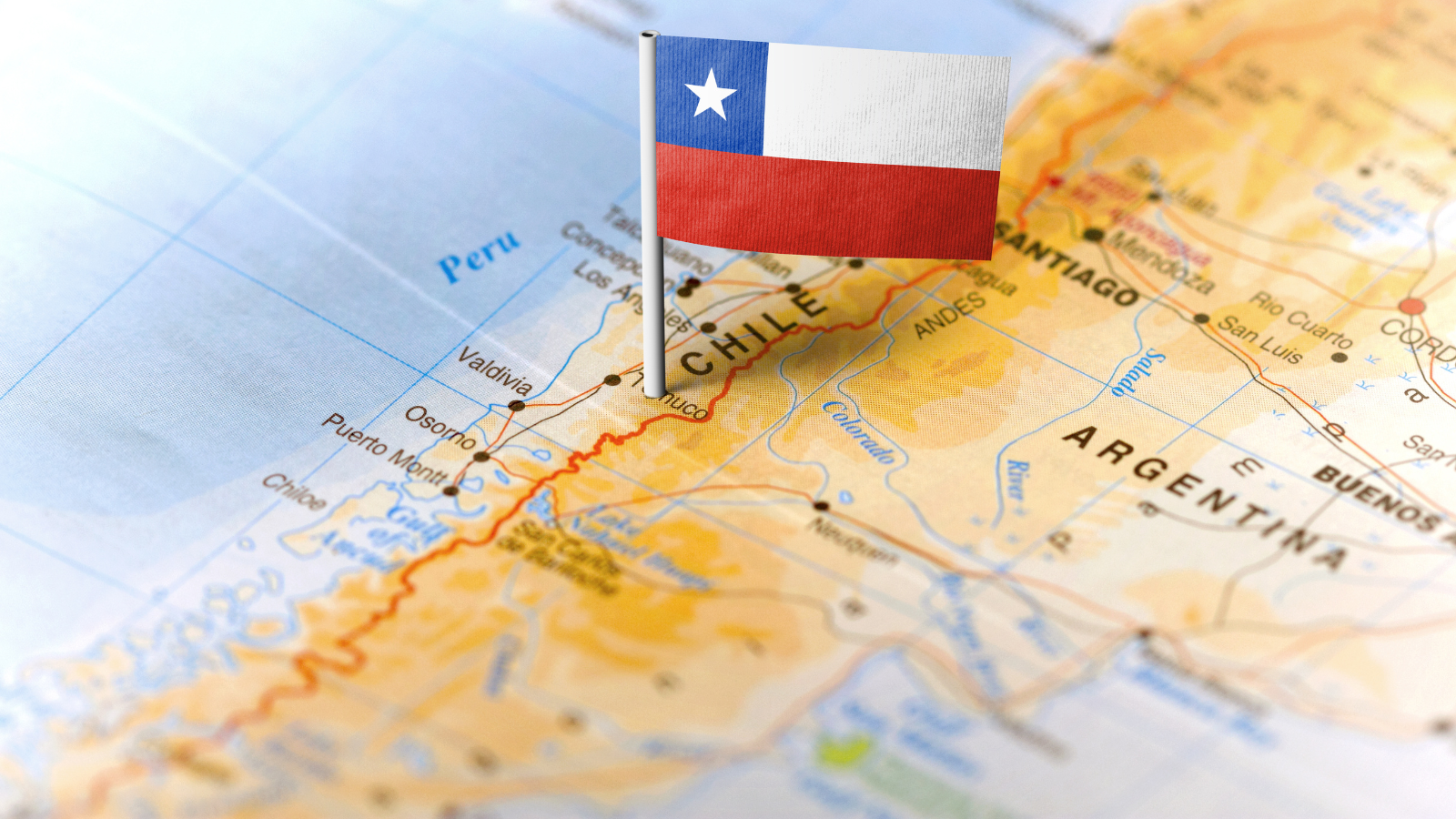
After a seven-year legislative journey, Chile has passed Law No. 21.719 on the Protection of Personal Data, a landmark regulation that modernizes the country’s privacy framework and establishes the new Personal Data Protection Agency. Officially published on 13 December 2024, the law will take effect on 1 December 2026.

This reform brings Chile in line with international data protection standards and introduces a structured compliance framework for organizations handling personal data, making early preparation essential for businesses operating in the country.

Background

Chile’s previous data protection framework, Law No. 19.628 on the Protection of Private Life, had long been criticized as outdated. This new legislation draws heavily from the EU General Data Protection Regulation (GDPR), reinforcing transparency, accountability, and individual rights in data processing.

The establishment of an independent Personal Data Protection Agency marks a major institutional shift — providing a single authority to oversee compliance, investigate breaches, and sanction violations.

Key Obligations

Under Law No. 21.719, companies and organizations processing personal data must implement a robust set of measures, including:

  • Legal basis for processing: Every data processing activity must be justified, documented, and aligned with the law.

  • Enhanced transparency: Organizations must provide clear, accessible privacy policies and disclosures to data subjects.

  • Special protection for sensitive data: Biometric, health, geolocation, financial data, and information about minors require extra safeguards.

  • Breach notifications and confidentiality: Mandatory reporting of data breaches and strict confidentiality obligations are now required.

  • Oversight of service providers: Companies must ensure that any third-party service providers handling personal data also comply with the law.

  • Data protection impact assessments: High-risk processing activities must undergo formal impact evaluations.

  • International data transfers: Cross-border data transfers must meet Chile’s new regulatory standards.

  • Proportional obligations for SMEs: Small and medium-sized enterprises benefit from scaled security and transparency requirements suitable for their size.

Organizations are also encouraged to adopt a data protection compliance model, which includes appointing a Data Protection Officer and implementing internal control processes. While voluntary, certified compliance programs may serve as mitigating factors in potential sanctions.

Sanctions and Enforcement

The law introduces a detailed catalog of 30 infractions, categorized by severity.

Penalties can reach up to 20,000 UTM (approximately USD 1.39 million) for extremely serious breaches, with higher fines for repeat violations.

In addition to financial sanctions, the Agency has the authority to suspend data processing activities for up to 30 days, a measure that could significantly impact business operations.

How CRESCO Supports You with Data Privacy Compliance

Corpiya can help organizations navigate new regulations such as Chile’s new Personal Data Protection Law with confidence. From assessing current data practices and identifying gaps to designing robust compliance frameworks, we guide companies through every step of implementation.

Our experts can help define legal bases for processing, draft transparent privacy policies, conduct impact assessments, and ensure secure international data transfers. By tailoring solutions to your organization’s size and risk profile, Corpiya ensures you meet regulatory requirements efficiently while safeguarding your reputation and building trust with customers. To learn more or get started, contact us via the form below or at contact@corpiya.com

Disclaimer: This article is provided for general informational purposes only and does not constitute legal advice. Sebastien Gaddini is licensed to practice law in New York; this piece addresses business-expansion and compliance topics in a non-legal, informational capacity and should not be relied upon as legal counsel. For advice specific to your situation, consult a qualified attorney licensed in the relevant jurisdiction.

Put These Insights Into Action

Talk to our team about how this applies to your operations — wherever your business takes you, Corpiya is ready to support your next move.

Get In Touch

Contact - Send us a message

Related Insights

Back to All Insights

Peru – UBO Affidavit Update

Peru - UBO Affadavit Update
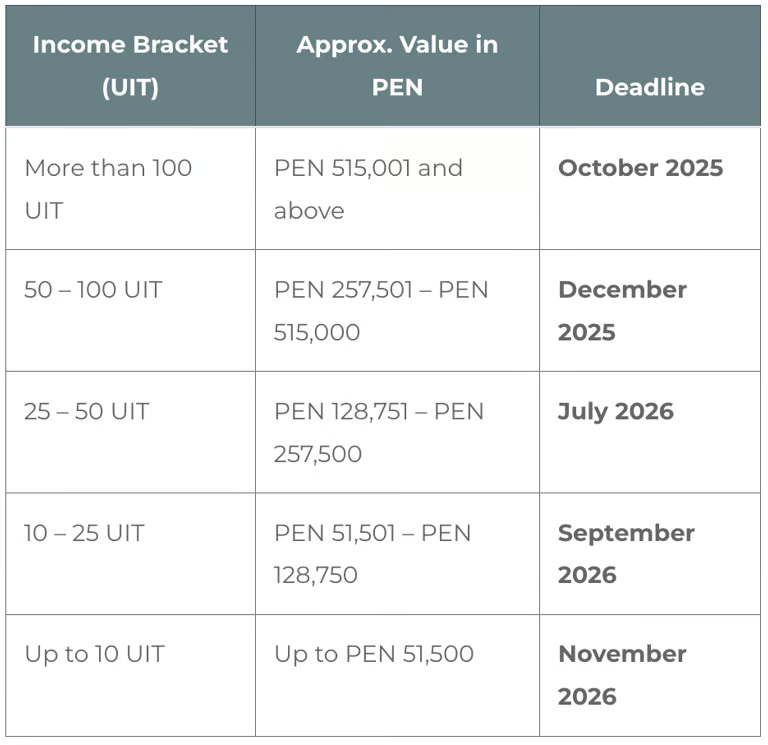
Peru Issues New UBO Filing Deadlines Under Resolution No. 000168-2025/SUNAT. The Superintendencia Nacional de Aduanas y de Administración Tributaria (SUNAT) has set new deadlines for Ultimate Beneficial Ownership (UBO) affidavits, with phased compliance running from October 2025 to November 2026. All Peru-domiciled entities must comply or face penalties of up to 0.6% of net income.

SUNAT has announced new deadlines

Deadlines for filing Ultimate Beneficial Ownership (UBO) affidavits further extend Peru’s framework for corporate transparency. Resolution No. 000168-2025/SUNAT, published on 28 May 2025, introduces updated filing requirements for an additional group of taxpayers. This resolution reinforces SUNAT’s broader objective of gradually expanding UBO reporting across all relevant legal entities in Peru.

Background

Peru first introduced UBO disclosure rules in 2019, marking a significant step in aligning with international standards on corporate transparency and anti-money laundering (AML). These rules were expanded in 2022, as part of SUNAT’s strategic roadmap to improve the detection of illicit financial activity and prevent the misuse of corporate structures. The 2025 resolution represents the next phase in this rollout, establishing a systematic and phased approach to bring nearly all Peru-domiciled entities into the UBO reporting regime.

Applicability and Deadlines

The new obligations apply to legal entities domiciled in Peru that were not already included in the earlier deadlines (2019, 2022). Deadlines are phased according to net income reported for Fiscal Year 2024, measured in Tax Units (UIT): The November 2026 deadline also applies to:
  • Legal entities not included in the above brackets or not required to file annual or monthly returns for FY2024.
  • Entities that activated their RUC (Taxpayer ID) up to December 2024, or registered between January 2025 and November 2026.
  • Legal arrangements established in Peru and registered in the RUC during October 2024–November 2026.
Entities registering after November 2026 must comply with deadlines applicable to the period in which they register or activate their RUC.

Definition of UBO

An Ultimate Beneficial Owner (UBO) is defined as:
  • An individual who ultimately owns or controls legal entities or arrangements, directly or indirectly.
  • An individual on whose behalf a transaction is carried out, or who exercises ultimate control over a client.
This definition includes ownership through chains of entities, indirect control, or other mechanisms of influence.

Why This Matters

UBO disclosure is part of a global trend toward greater corporate transparency, driven by the Financial Action Task Force (FATF) and adopted across multiple jurisdictions. By enforcing these rules, Peru is positioning itself as a stronger player in combating money laundering, tax evasion, and corruption. For multinational groups with operations in Peru, this means additional compliance layers — but also improved credibility in the global marketplace.

How Corpiya Can Support You

Corpiya assists businesses with navigating regulatory complexity across borders, including UBO reporting obligations. Our experts ensure that your entity remains compliant with SUNAT’s requirements while minimizing administrative burden. For tailored guidance on Peru’s new UBO deadlines, contact contact@corpiya.com

Disclaimer: This article is provided for general informational purposes only and does not constitute legal advice. Sebastien Gaddini is licensed to practice law in New York; this piece addresses business-expansion and compliance topics in a non-legal, informational capacity and should not be relied upon as legal counsel. For advice specific to your situation, consult a qualified attorney licensed in the relevant jurisdiction.

Put These Insights Into Action

Talk to our team about how this applies to your operations — wherever your business takes you, Corpiya is ready to support your next move.

Get In Touch

Contact - Send us a message

Related Insights

Back to All Insights